
West Asia war posing challenge to India’s economy, government working on comprehensive strategy: Modi

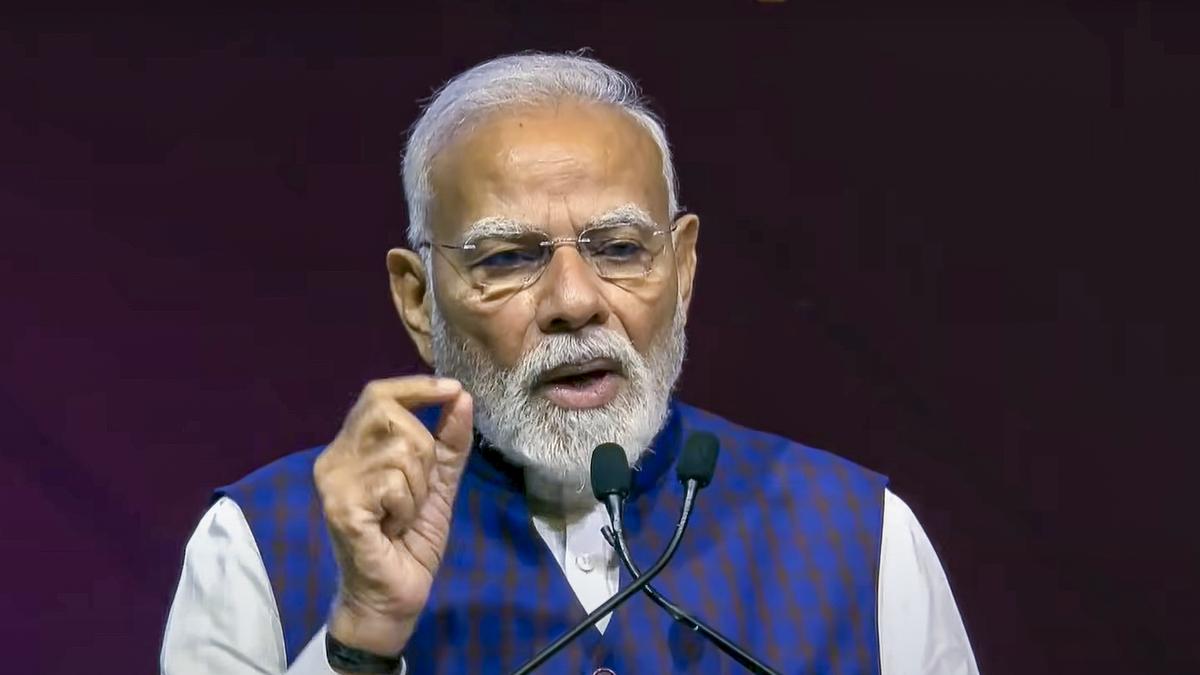
New Delhi, Mar 23: With the West Asia war disrupting flow of energy critical for India’s economy, Prime Minister Narendra Modi today said his government is working with a comprehensive short-term, medium-term, and long-term strategy to meet the challenge.
A dedicated Inter-Ministerial Group meets daily to assess and resolve every difficulty in India’s import-export chain, he said while making a statement in Parliament on the West Asia war, its impact on India and how the government is addressing the challenge.
“I am fully confident that through the joint efforts of the government and industry, we will be able to face these circumstances effectively,” Modi said in the Lok Sabha as he gave a detailed overview involving diplomatic and domestic efforts.
Energy, he noted, is the backbone of the modern economy and that West Asia is a major source for global energy needs, making the current crisis a challenge for economies worldwide.
He pointed out that large quantities of crude oil, gas, fertilizers, and other essentials come to India through the Strait of Hormuz and that movement through this maritime route has become highly challenging since the beginning of the war on February 28.
He said the government’s focus has been on protecting ordinary families from hardship, and talked about measures taken, including prioritizing domestic use of LPG and boosting its domestic production.
“Continuous work has been done to ensure that the supply of petrol and diesel continues smoothly across the entire country,” he said.
He mentioned efforts of the government to diversify energy options and said over the last one decade, the country has expanded its energy import sources from 27 countries to 41 countries over the past 11 years, thereby reducing dependence on any single region.
Modi said stockpiling of crude oil has been done for precisely such times of crisis.
“Today, the country possesses a Strategic Petroleum Reserve of more than 53 lakh metric tonnes, with work underway to build reserves exceeding 65 lakh metric tonnes, in addition to the separate reserves held by oil companies,” the Prime Minister said.
Talking about India’s refining ecosystem, he said, “Over the past 11 years, there has been a remarkable increase in our refining capacity as well.”
On diplomatic front, the Prime Minister talked about the government’s active engagement with global suppliers and its vigilant monitoring of Gulf shipping routes to ensure the safe passage of ships carrying oil, gas, fertilizers, and other essential goods to India.
He said there has been a continuous dialogue with all global partners to keep maritime corridors secure and “Due to such efforts, several of our ships that were stuck in the Strait of Hormuz have also arrived in India in recent days.”
Regarding India’s domestic energy transformation, Modi spoke about progress in ethanol blending, from a mere 1–1.5 percent a decade ago to nearly 20 percent today.
This, he said, has reduced oil imports by approximately four and a half crore barrels per year.
On the impact of the war on the agriculture sector, the Prime Minister said adequate food grain stocks are available
The government is working to facilitate proper Kharif sowing and has built robust emergency food arrangements in recent years, he added.
Comparing the current situation to that of the Corona crisis, Modi said, “In the past too, our government did not allow the burden of global crises to fall on the farmers.”
“Even during the COVID-19 pandemic and associated global supply chain disruptions, when urea prices soared to ₹3,000 per bag in international markets, the government ensured that Indian farmers received the same bag at less than ₹300,” he said.
He said structural steps have been taken to insulate Indian agriculture from external shocks.
He noted that six new urea plants have been commissioned in the last decade, adding over 76 lakh metric tonnes of annual production capacity, while domestic output of DAP and NPKS fertilizers has been increased by approximately 50 lakh metric tonnes and fertilizer import sources have been diversified.
“Just as we have diversified oil and gas imports, we have also expanded our options for the import of DAP and NPKS,” he said.
About the power sector, Modi said all systems from electricity generation to supply are being continuously monitored.
The government’s preparedness has been significantly bolstered by the transformative strides made in renewable energy over the past decade , with half of India’s total installed power generation capacity now coming from renewable sources and the country’s total renewable capacity crossing the historic milestone of 250 gigawatts, he said.
He said adequate coal stocks are available at all power plants across the country s a record production of 100 crore tonnes of coal has been recorded for the second consecutive year.
He added that solar power capacity alone has surged from approximately 3 gigawatts to 140 gigawatts in the past 11 years, about 40 lakh rooftop solar installations have been set up, 200 Compressed Biogas plants are now operational under the GOBARdhan Scheme.
Nuclear energy production is being encouraged alongside a newly approved Small Hydro Power Development Scheme that will add 1,500 megawatts of capacity over the next five years, PM Modi said.
“All these efforts are serving the country greatly today, and they will make India’s energy future even more secure,” he said. (BVI)
