
West Asia war impact: India’s economic outlook deteriorating, according to an analysis
Geopolitical energy shock has triggered market declines, currency weakness and fiscal strain, according to Shriram Mutual Fund.

New Delhi, Apr 9: The economic outlook of India is deteriorating rapidly in view of the geopolitical energy shock which has triggered market declines, currency weakness and fiscal strain, according to Shriram Mutual Fund.
In its quarterly report, the fund house described the January-to-March period as “a quarter of two halves”, with early optimism from trade deals giving way to a sharp reversal driven by the West Asia war and the consequent spike in crude fuel prices.
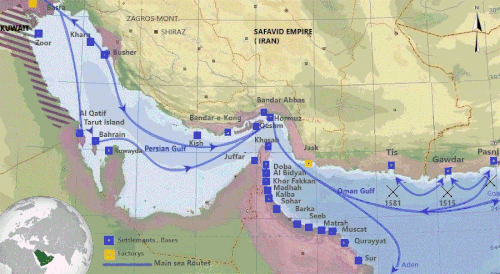
The international crude prices, which were around USD 78 per barrel in mid-February, surged to above USD 115 by late March due to the West Asia war and the disruption in flow of energy through the Strait of Hormuz.
Around 20 per cent of global supply flows through the Strait of Hormuz, including over 60 per cent of India’s crude imports.
The impact on Indian markets has been severe. The Nifty 50 index fell 11.3 per cent in March, taking year-to-date losses to 14.4 per cent, while midcap and smallcap indices also recorded double-digit declines.
Foreign institutional investors have been net sellers for five consecutive weeks, exacerbating the sell-off and adding pressure on the rupee, which weakened from around Rs 90 per USD at the start of the year to beyond Rs 94 by late March.
“The speed and severity of this deterioration has caught most market participants… by surprise,” the fund said.
The energy shock is also feeding into India’s macroeconomic vulnerabilities as the higher oil import bill is widening the current account deficit.
The foreign exchange reserves have declined by roughly USD 18–20 billion over the quarter as the central bank intervened to stabilise the currency.
Shriram Mutual Fund warned that continued depreciation could force the Reserve Bank of India into aggressive monetary tightening, similar to its response during the 2013 taper tantrum.
On the fiscal front, the government’s efforts to shield consumers from rising fuel prices through excise duty cuts and subsidies are straining public finances. The report said under-recoveries for oil marketing companies are running into “several thousand crores per month”, raising concerns over sustainability.
As a result, the fund expects the fiscal deficit to overshoot its earlier target of 4.5 per cent of GDP for FY27, potentially widening to 5.0–5.3 per cent, in line with market estimates. Bond yields have already reacted, with the 10-year government bond yield rising to above 7.0 per cent from about 6.6 per cent in late February.
Beyond financial markets, the report highlighted broader economic risks. Supply disruptions have led to shortages of liquefied petroleum gas, forcing prioritisation of household consumption over industrial use. Reports of restaurant closures and curtailed industrial activity are emerging, signalling potential supply-side stress.
The crisis could also affect remittances, a critical support for India’s external balance. The country receives over USD 45 billion annually from Gulf nations, and prolonged disruption in the region may reduce inflows, adding further pressure on the rupee.
Agriculture is another area of concern, with potential fertiliser shortages due to disruptions in Gulf production of urea and ammonia, coinciding with the upcoming Kharif sowing season.
The report also flagged an unexpected development in financial markets: the failure of gold and silver to act as effective hedges. Both assets declined during the recent sell-off as investors liquidated positions to meet margin calls, reflecting a shift in ownership towards short-term speculative capital.
Despite the near-term challenges, the fund outlined two scenarios. A swift resolution of the conflict by mid-May could lead to a sharp recovery in equities, stabilisation of oil prices to USD 85–90 per barrel and improvement in macro conditions.
However, a prolonged conflict could trigger further equity declines and earnings downgrades of 10–15 per cent for benchmark indices, particularly impacting sectors such as automobiles and industrials.
The fund said it has reduced exposure to oil marketing companies while increasing allocations to upstream energy firms and refiners, which benefit from higher crude prices.
“Periods of heightened uncertainty… have historically been followed by strong recoveries,” it said, urging investors to remain cautious but avoid exiting at distressed levels. (BVI)
