
Rail Minister unveils 8 more reforms to strengthen freight business

By Arun Kumar Das
New Delhi, July 14: Railways Minister Ashwini Vaishnaw today announced eight more structural reforms to modernise Indian Railways and strengthen freight transportation.
With this, the total number of reforms announced under the ‘Reforms Express’ initiative has reached 17, he said.
The new reforms will bring significant changes in freight operations, logistics, construction practices, project execution, wagon design, skilling and ease of doing business.
Addressing the media, Vaishnaw said that Indian Railways is undertaking a series of reforms to build a future-ready railway system.
These reforms are part of the Ministry’s target of implementing 52 reforms in 52 weeks to enhance efficiency, promote innovation and strengthen the railway ecosystem.
Vaishnaw said 9 reforms were announced earlier under the ‘Reform Express’ initiative and that those have already started yielding encouraging results.
Reform No. 10: Fly Ash Transportation
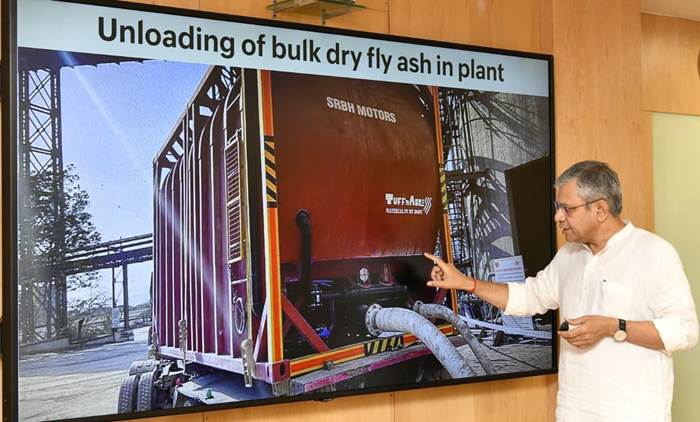
Fly ash has traditionally been transported through open wagons, resulting in dust pollution during loading, transportation and unloading.It also poses a significant environmental challenge when stored in large ash ponds at thermal power plants.
To address these issues, Indian Railways has introduced a new containerised transportation system for fly ash.
Under the new policy, specially designed ISO-standard containers will be used for transportation.
The containers can be handled through reach stackers, allowing seamless end-to-end movement from power plants to cement plants.
Reform No. 11: Container Sector
To promote container traffic, Indian Railways has undertaken a major structural reform in the container train operator licensing framework.
He said that under the existing system, Container Train Operator (CTO) licences were issued under four categories (Category I–IV), with a registration fee of ₹50 crore for Category-I and ₹10 crore for each of the other categories, along with route-specific restrictions and different registration requirements. This has now been replaced by a single unified Pan-India Container Train Operator licence.
Reform No. 12: Fertilizer Transportation
Vaishnaw said Indian Railways currently handles nearly 85 per cent of fertilizer transportation in the country.
He said that the existing freight charging system comprised nearly fifty different slabs, making operations complex.
Under the new reform, freight charges have been simplified to a per tonne per kilometre basis with a rationalised tariff structure comprising three variations.mage and improve overall logistics efficiency.
Reform No. 13: Policy for Skilling Artisans in Railway Projects and Works
Vaishnaw said that railway infrastructure projects involve safety-sensitive operations requiring specialised skills, precision engineering and adherence to strict quality standards.
To ensure deployment of competent manpower, Indian Railways has introduced a comprehensive policy for skilling artisans engaged in railway projects and works.
The policy establishes a structured framework for identification, assessment and certification of workers engaged in critical trades such as welding, fitting, masonry and other specialised construction activities.
Reform No. 14: Construction Reforms
Indian Railways has undertaken another major set of reforms to strengthen the construction ecosystem and improve project execution.
As part of the reforms, 10 per cent Performance Security will now be obtained at the commencement of the contract instead of being recovered through deductions from running bills.
The reforms further introduce Contractor’s All Risk Insurance and Professional Indemnity Insurance to strengthen risk management during project execution and provide protection against construction-related risks.
Reform No. 15: Policy for Wagon Design Approval
Vaishnaw announced a new policy for wagon design approval aimed at promoting innovation and enabling industry participation in designing specialised freight wagons.
Under the new policy, designers, manufacturers and industries will be able to develop and propose wagon designs suited to specific commodities and operational requirements.
After detailed design, prototype manufacturing and rigorous static and dynamic testing, a full rake will undergo field trials before safety certification, inspection by the Chief Commissioner of Railway Safety and approval by the Railway Board for induction into service.
Reform No. 16: Petroleum Products Transportation
Vaishnaw said transportation of petroleum, oil and lubricant (POL) products requires specialised tank wagons. But the existing system, under which Indian Railways owns all tank wagons, restricts flexibility for oil companies to introduce specialised wagons suited to their operational requirements.
To address this, Indian Railways has removed the structural barriers governing design and induction of petroleum tank wagons.
Oil companies will now be able to procure specialised wagons directly or lease them through leasing agencies and induct them on the Indian Railways network for specialised requirements.
Reform No. 17: Foodgrains, Flour and Pulses Transportation
Vaishnaw said Indian Railways has also introduced a major reform for transportation of foodgrains, flour and pulses by simplifying freight charges and promoting containerised movement.
Under the new policy, the earlier complex slab-based freight structure has been replaced with a simplified per tonne per kilometre rate structure.
The reform permits transportation of foodgrains, flour and pulses through containers, enabling easier handling, flexible storage and phased distribution based on operational requirements.
The Minister said containers can be stored at the premises of sellers or buyers and distributed according to demand, without detaining an entire rake.
Since the containers remain sealed, the possibility of contamination is significantly reduced, thereby improving the safety and quality of foodgrain transportation while enhancing logistics efficiency. (BVI)
