
India Bets on Dual-Airport Strategy as Jewar Hub Comes Online
First phase of Noida International Airport was inaugurated today

By R. Suryamurthy
New Delhi, Mar 28: The completion and inauguration of Phase-1 of the Noida International Airport today marks more than the addition of a new aviation facility — it reflects a deeper recalibration of how India plans to build capacity, distribute growth, and reconcile infrastructure expansion with climate commitments.
Executed by Tata Projects Limited and developed by Yamuna International Airport Private Limited, a subsidiary of Zurich Airport International AG, the greenfield airport is being positioned as India’s first net-zero emissions aviation hub, even as it steps in to relieve mounting capacity pressure at Indira Gandhi International Airport.
With a Phase 1 capacity of 12 million passengers annually—roughly equivalent to a mid-sized metro airport—the project introduces a second aviation node in the National Capital Region (NCR), about 75 km from Delhi.
The strategic logic is clear: as Delhi’s primary airport approaches saturation, incremental expansion within an already dense urban footprint has limits.
Jewar, by contrast, offers scale—over 1,300 hectares in its initial footprint—and the flexibility to expand to as much as 70 million passengers annually over the next two decades, with provisions for multiple runways.
Yet the significance of the project lies as much in its design philosophy as in its scale.
Jewar Airport in Noida inaugurated; flight operations likely from next month
Unlike legacy airports that retrofit green features, Noida International Airport has been conceived around a net-zero framework from the outset. Renewable energy integration—spanning solar and wind—sits alongside water recycling systems, rainwater harvesting, and the use of low-carbon construction materials.
For policymakers, the project functions as a test case: whether large-scale, carbon-intensive infrastructure like airports can align with India’s broader climate commitments without compromising growth. India’s aviation sector is among the fastest growing globally, but also one of the harder sectors to decarbonise.
Executives at Tata Projects say the airport’s construction—completed with over 85 million safe man-hours and a workforce exceeding 100,000—demonstrates that sustainability and scale need not be mutually exclusive. Still, the real test will lie in operations: maintaining net-zero status over time, particularly as traffic scales up and energy demand rises.
Functionally, Jewar is not designed to compete directly with Delhi’s IGI but to complement it—creating a dual-airport system similar to those in global megacities. The distance between the two airports, coupled with planned multimodal links including metro extensions and regional rapid transit systems, suggests a future where passenger and cargo flows are distributed rather than concentrated.
This shift is critical. IGI is projected to handle over 100 million passengers annually in the coming years, pushing against both slot and land constraints. By diverting incremental demand—especially cargo and low-cost traffic—towards Jewar, planners hope to extend the operational life of Delhi’s aviation infrastructure while unlocking new growth corridors in western Uttar Pradesh.
Beyond aviation metrics, the airport is already reshaping regional economics. Land values along the Yamuna Expressway have surged, industrial and logistics investments are clustering in anticipation, and the state government is positioning the project as a cornerstone of its ambition to build a $1 trillion economy.
Estimates suggest the airport could generate over ₹2 lakh crore (roughly $24 billion) in economic activity by the late 2030s, alongside nearly a million jobs across direct and indirect channels. The emphasis on cargo infrastructure in Phase 1—often overlooked in passenger-centric narratives—signals a deliberate push to reduce India’s logistics costs, which currently hover around 13–14% of GDP.
In effect, the airport is being built not just as a transport node, but as the nucleus of a broader “aerotropolis”—a cluster of logistics parks, warehousing zones, data centres, and urban settlements that extend the economic footprint of aviation infrastructure.
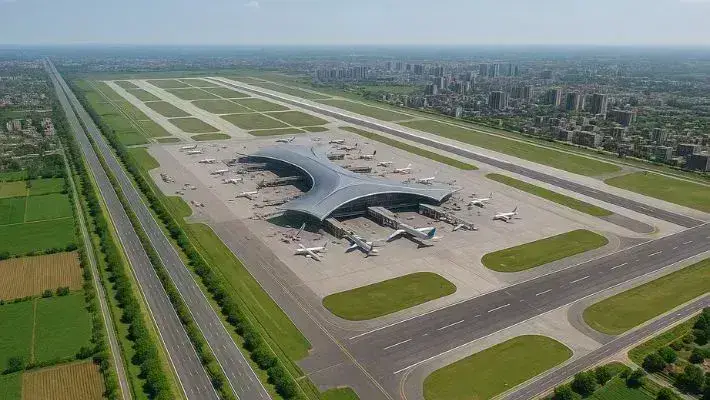
Architecturally, the airport attempts a balancing act between global efficiency and local identity. The terminal—spanning over 100,000 square metres—features a wavy roofline inspired by regional rivers, courtyard-style layouts reminiscent of traditional Indian havelis, and interiors incorporating local crafts.
This is not merely aesthetic. Passive design elements—natural lighting, ventilation, and spatial flow—are integral to reducing energy consumption, aligning with the airport’s sustainability goals while shaping passenger experience.
While the project underscores the growing capability of Indian EPC firms to deliver complex infrastructure, questions remain on timelines and utilisation. Although inaugurated, commercial operations are expected to begin in phases over the coming months, subject to final operational readiness and airline alignment.
There are also early signs of friction at the local level. Some residents who ceded land for the project have raised concerns over employment quality and access, highlighting a familiar challenge in large infrastructure projects: translating macroeconomic gains into equitable local outcomes.
For now, Noida International Airport stands at the intersection of multiple policy priorities—capacity expansion, regional development, sustainability, and private sector participation under a public-private partnership model.
Whether it ultimately succeeds will depend on execution beyond construction: traffic ramp-up, connectivity integration, airline adoption, and the ability to sustain its net-zero ambition at scale.
But its broader significance is already evident. In an infrastructure landscape often defined by incremental upgrades, Jewar represents a more structural bet—that India’s next phase of growth will be built not just by expanding existing systems, but by creating entirely new ones, designed for the demands of a different economic and environmental era. (BVI)
