
India’s First Bullet Train Project Showcases Sleek High-Speed Train Design

By Arun Kumar Das
New Delhi, May 19: India’s ambitious Mumbai–Ahmedabad high-speed rail project, widely known as the bullet train project, has offered a first official glimpse of what the country’s first high-speed train may look like.
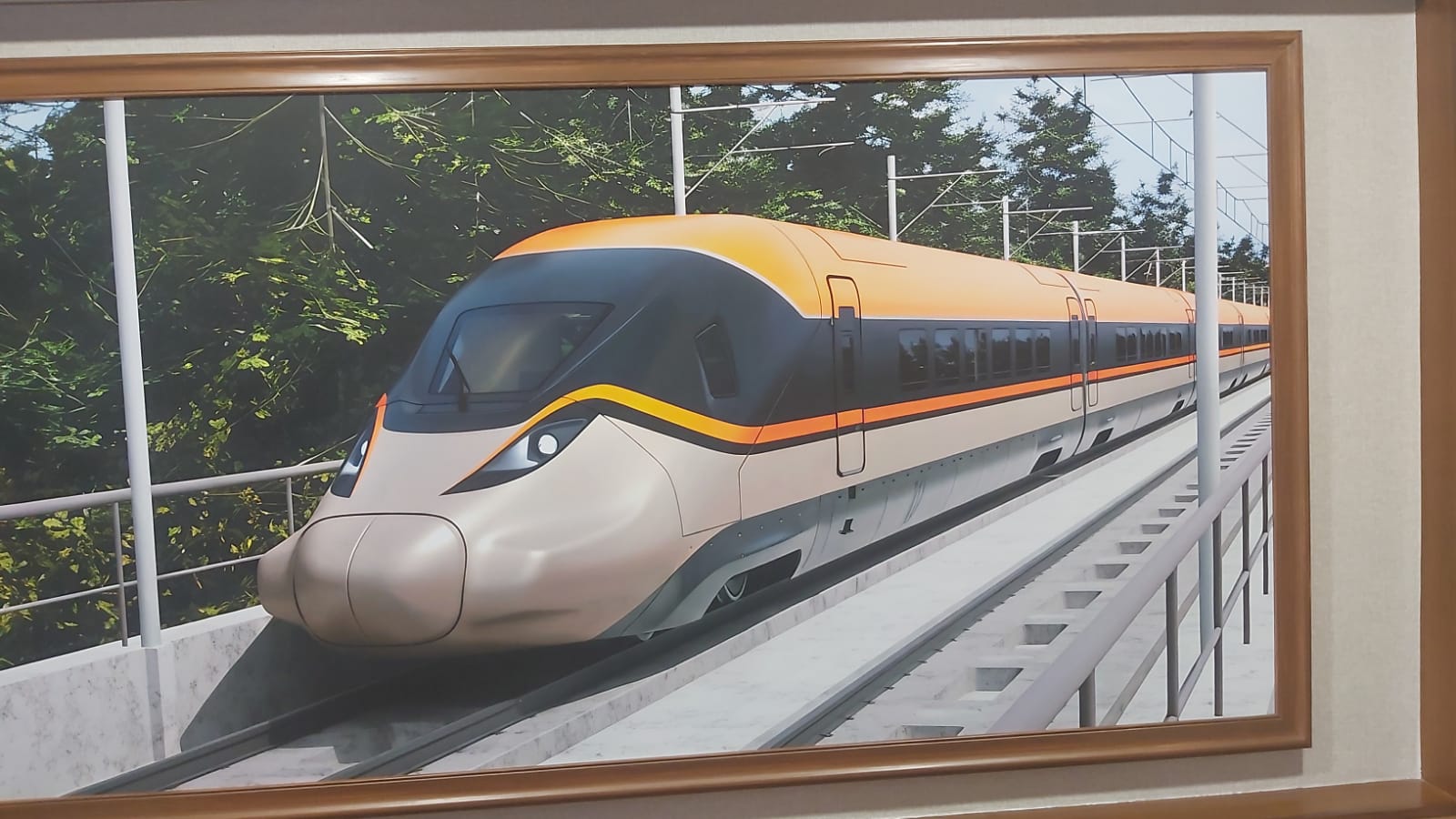
Nearly nine years after the foundation stone was laid by Prime Minister Narendra Modi, the Ministry of Railways has displayed a framed concept image of the train at Rail Bhawan, signalling steady progress on the long-awaited infrastructure project.
A Shinkansen-inspired modern design
The showcased design features a streamlined, aerodynamic body with a rounded nose, drawing visual similarities to Japan’s Shinkansen trains. The train is depicted in a grey exterior with orange and gold accents, running on an elevated viaduct through a green landscape.
The design reflects India’s push toward modern, energy-efficient, and high-speed rail transport.
Speed, technology and manufacturing details
The trains are being developed to operate at:
- Maximum speed: up to 280 kmph (with track design allowing up to 320 kmph)
- Average operational speed: around 250 kmph
Manufacturing and development work is being handled under contracts involving Indian Railways and BEML Limited, while coach production is expected to be led by the Integral Coach Factory (ICF).
Each coach is estimated to cost around ₹28 crore.
Massive project scale and rising cost
Originally sanctioned at around ₹1.08 lakh crore, the project cost has now increased to nearly ₹1.98 lakh crore due to delays in land acquisition and changes in scope.
Funding support includes a concessional loan from Japan at 0.1% interest over 50 years, covering a significant portion of the original project cost.
Timeline: When will India get its bullet train?
Railway officials have outlined a phased rollout plan:
- 2027: First operational section (likely Surat–Vapi stretch)
- 2028: Extension up to Thane
- 2029: Full Mumbai–Ahmedabad corridor completion
Railway Minister Ashwini Vaishnaw has indicated that India could see its first operational section as early as Independence Day 2027.
Major engineering milestone in Mumbai
A key breakthrough has also been achieved in Mumbai, where the first cutterhead of a Tunnel Boring Machine (TBM) has been lowered at Vikhroli.
- TBM diameter: 13.6 metres
- Weight: 350 tonnes (cutterhead)
- Full machine weight: over 3,000 tonnes
These machines will construct a 16 km underground stretch, including a 7 km undersea tunnel beneath Thane Creek a first for India’s railway network.
The tunnel will connect Vikhroli to the Bandra Kurla Complex (BKC) station, passing under dense urban zones and the Mithi River.
