
IIT Jodhpur Researchers develop ‘Ultralight and Ultrastrong Supermetal’ which can benefit aerospace sector

Jodhpur, Oct 29 (BVI) Researchers at the Indian Institute of Technology (IIT) Jodhpur have developed a revolutionary Titanium-Aluminide (TiAl) alloy that is set to redefine materials used in the aerospace and defence sectors, according to the institute.
This new material, named TiAl-CA, solves long-standing challenges in developing lightweight metals for jet engine components, achieving an unprecedented combination of high temperature strength and low weight, it said in a statement.
Current alloys used in aircraft engines are either too heavy or become weak at the high temperatures where engines operate.
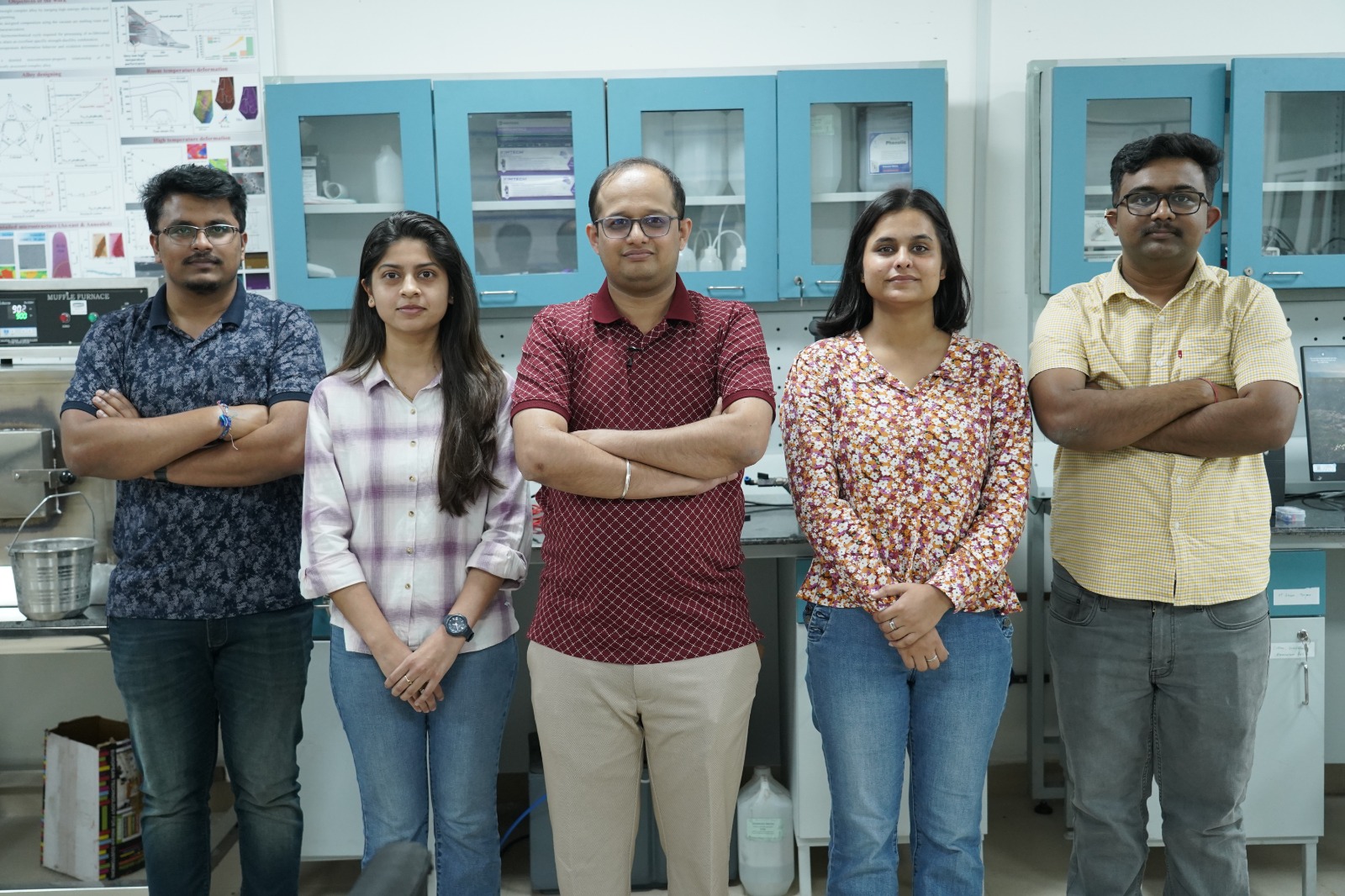
The new material—developed by Prof. S. S. Nene, and his team (Ph.D. students A. R. Balpande, and A. Dutta) from Advanced Materials Design and Processing Group, Department of Materials Engineering, Indian Institute of Technology Jodhpur—maintains a gigapascal-level yield strength—a measure of its incredible resilience—even at soaring temperatures of 900 °C.
Crucially, it achieves this unprecedented yield strength while retaining excellent oxidation resistance at elevated temperatures, which is a major engineering breakthrough.
What makes TiAl-CA unique is its composition. Previous high-strength TiAl alloys required the addition of elements like boron or carbon, which made them brittle and difficult to work with.
The performance of TiAl-CA is truly remarkable. It not only achieves a yield strength of approximately 1.1 GPa at room temperature but also maintains this strength even at 900 °C, the statement said.
To put its lightweight strength into perspective, the new alloy’s ability to retain its strength at high temperatures surpasses that of traditional Nickel-based superalloys (like IN718) under compressive loading. Most importantly, it accomplishes this while being nearly half the density (4.13 g/cc) of those conventional Ni based superalloys (7.75-9.25 g/cc), it said.
The successful design of this ultralight, yet ultra-strong alloy promises a massive advantage for manufacturing fuel-efficient aeroengine components, it said.
Its adoption in the aerospace and defence sectors could significantly reduce the weight of components, leading to greater efficiency and a smaller carbon footprint.
The researchers plan to pursue further testing, including scaling up casting volumes and testing for creep and fatigue, to bring this next-generation material closer to real-world application. (BVI)
