
Bullet Train Project: Construction of 16-km-long tunnel in Maharashtra starts
The tunnel includes India’s first 7-km-long undersea part which is beneath the Thane Creek.

By Arun Kumar Das
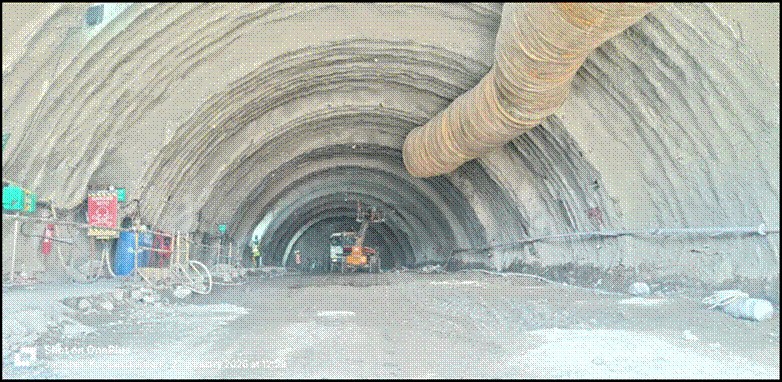
VIKHROLI (MAHARASHTRA), Apr 11: In further progress on the Mumbai-Ahmedabad Bullet Train project, construction work has commenced on 16-km-long tunnel between Bandra Kurla Complex (BKC) and Sawli (near Ghansoli) in Maharashtra.
The tunnel includes India’s first 7-km-long undersea part which is beneath the Thane Creek.
Out of 21 kms, construction of 5 kms of the tunnel has already been completed and the remaining 16 km through Tunnel Boring Machines (TBM).
The tunnel will be a single tube tunnel of 13.1 m diameter to accommodate twin tracks. This tunnel will be about 25 to 57 Meters deep from the ground level and the deepest construction point will be 114m below the Parsik hill.
The process began with the lowering of one of the six segments of the main shield, weighing approximately 170 metric tonnes.
This segment measures about 8.66 metres in length and approximately 7 metres in width and was lowered at a depth of 56 metres below ground level—equivalent to a 20-storey building, at Vikhroli, Maharashtra.
Two Tunnel Boring Machines (TBMs) have been received and the tunnelling operations will commence following comprehensive testing and commissioning.
To lower the TBMs, three shafts have been constructed which include Shaft 1 for retrieval shaft at BKC, Shaft 2 in Vikhroli and Shaft 3 in Sawli (near Ghansoli).
TBM 1 will start from Shaft 2 at Vikhroli and will move towards Shaft 1 of Mumbai Bullet Train station at BKC while TBM 2 will start from Shaft 3 at Sawli and move towards Vikhroli (graphic attached).
The two TBMs, weighing 3080 tons (TBM-1) and 3184 tons (TBM-2) respectively, are the most advanced tunnelling machines deployed in the country. These advanced TBMs, based on Mix Shield / Slurry technology, are specifically designed to operate in complex geological conditions.
Each TBM measures 95.32 metres in total length and comprises several critical components, including the cutter wheel, main bearing, jaw crusher, erector, main shield, tail shield, and four specialized gantries that support tunnelling operations.
These machines can operate at a maximum cutterhead speed of 4 RPM (revolutions per minute), with a maximum excavation rate of 49 mm per minute, enabling steady and controlled tunnelling progress while maintaining high safety standards. (BVI)
