
India’s largest underground station being constructed for first Bullet Train
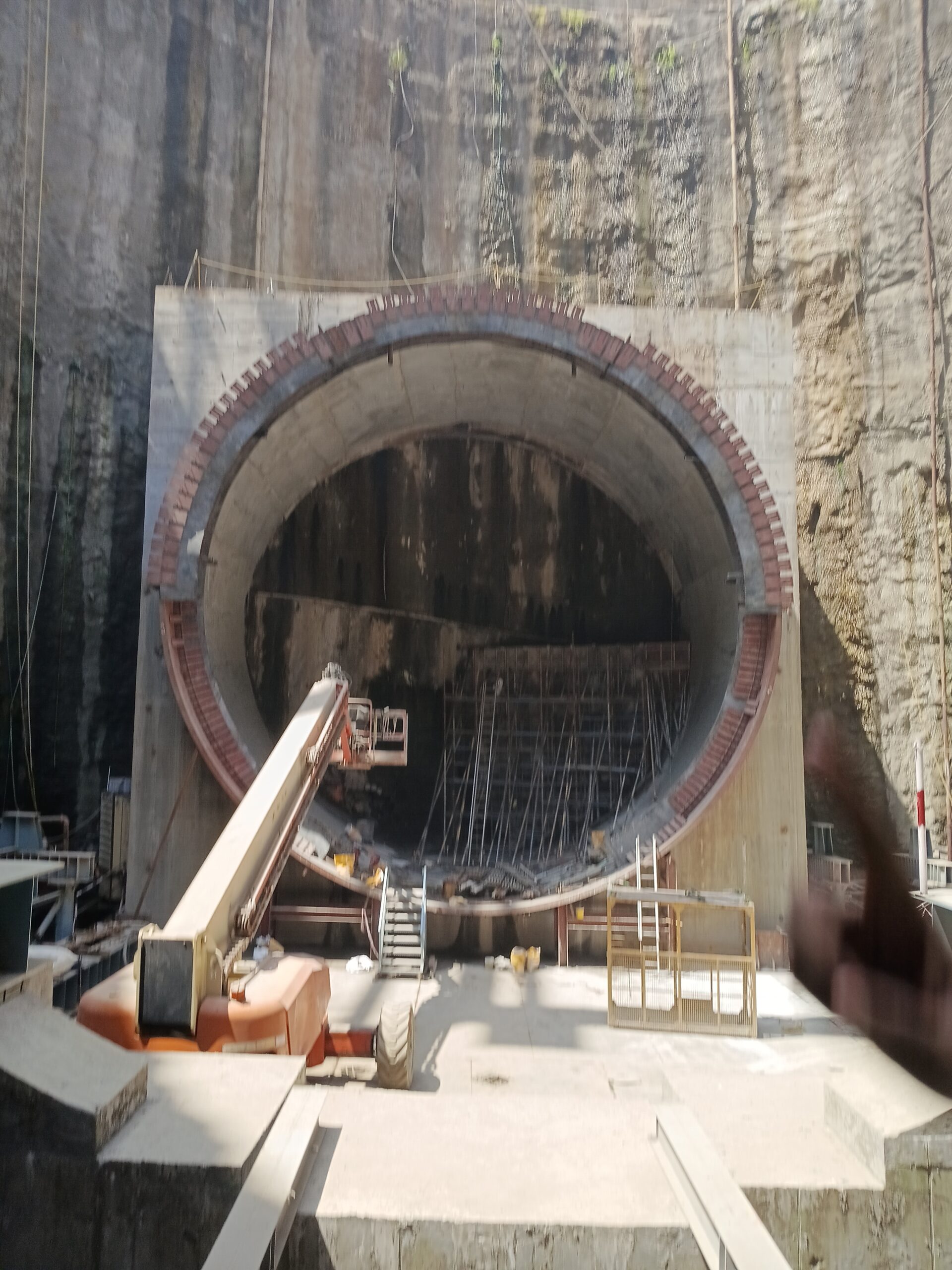
GROUND REPORT: This tunnel for the Bullet Train project will be 21 kms long. Work has already completed on 5 kms using the New Austrian Tunnelling Method,

By Arun Kumar Das
BANDRA KURLA COMPLEX (MUMBAI), Apr 6: It’s summer time as the mercury is on the constant rise in this part of the financial capital of the country amid the volatile condition in the finance sector due to the Gulf war. However, seemingly oblivious of the outside situation, Sukumar and Murad are busy in excavation work for the 21-km long tunnel of India’s first bullet train project in Mumbai.
Sukumar and Murad are part of a 100-odd strong highly skilled workforce busy round the clock to construct the tunnel as well as one of the largest underground stations at Bandra Kurla Complex (BKC) for the 350 KMPH bullet train.
According to the available data, there will be a requirement of 14 lakh tons of concrete to be used for the underground BKC station, which could fill 200 Olympic size swimming pools.
Since the structure of BKC station will be equivalent to a 10-storey building, the concrete requirement is also huge, said enthusiast site engineer at the site.
The excavation work is going on amid the high pressure gas pipeline, water pipe, petrol pump and about 50 high rise buildings. The excavation work has been completed in 5 km by New Austrian Tunnel Boring Machine (NATM) from Silphata to Ghansoli part of the 21-km tunnel stretch of the Mumbai-Ahmedabad High Speed Rail (MAHSR) project.
We have to do controlled blasting along with vibration monitoring for the 35 metre deep tunnel here, said the site engineer.
The skilled workforce is entrusted to do the groundwork for installing the specially designed Tunnel Boring Machine (TBM) to do the required drilling work. The long awaited 3150-ton TBM was designed in Germany and assembled in China.
There will be two TBMs required for the drilling work for India’s maiden bullet train project. The TBM is 96 metre long and currently the largest one in the country which will be used for the first time in India when a mixed-shield TBM of this scale, with a diameter of 13.65 metres, is deployed in an infrastructure project.
In a major step forward, the two TBMs have already arrived at JNPT and are in the process of installation at Vikhroli and Savali sites, to begin further excavation and expected to be operational in July.
Of the 21-km tunnel, 5 km has already been completed using the New Austrian Tunnelling Method, which involves blasting, while the finishing work is ongoing. The remaining excavation will now be carried out by TBM.
Of the 508-km bullet train project, tunnels account for 27.4 km. Of this, 21 km comprises underground tunnels, while 6.4 km consists of surface tunnels.
Transporting its components to the site will require over 150 trailers, and assembling the machine is expected to take approximately 90 days.
The use of a TBM ensures a much safer excavation process, especially since the tunnel passes through a densely populated area where conventional blasting methods would pose significant risks.
The project includes the excavation of a 7-km undersea tunnel, which demands exceptional precision and advanced engineering capabilities,” he added.
A major breakthrough in the 4.88-km underground tunnel between Ghansoli and Shilphata was achieved in September 2025. This stretch, part of the 21-km tunnel in construction between Bandra-Kurla Complex and Shilphata in Maharashtra, also includes a 7-km undersea section beneath the Thane Creek.
The tunnel is a single tube tunnel to accommodate twin tracks for both-up and down track. 39 equipment rooms at 37 locations will also be constructed adjoining the tunnel location as part of the package.
To construct this tunnel, TBMs with a cutter head of 13.65 Meter diameter are being used. Usually, 5-6 Meter Diameter cutter heads are used for urban tunnels used in MRTS – Metro system.
This is a congested commercial area so we have to do blasting carefully for the tunneling work, the engineer said.
The 35 metre depth tunnel will have three levels – B1, B2 and B3. While B3 will have a platform, B2 to have a concourse and B1 will have an equipment room.
The 415 metre long platform will accommodate 16-coach Bullet Train.
There is a chiller plant specially operational near the site to keep the temperature under control. Concretes are mixed with ice cubes to keep the temperature under 25 degrees, said the site supervisor.
The entire tunnel design, safety protocol and quality parameters are being finalised by the Japanese as per the agreement with Japan. Japanese experts keep visiting the sites on a regular basis and there is no scope for any compromise or deviation, he said.
The bullet train project spans 352 km in Gujarat and Dadra & Nagar Haveli, and 156 km in Maharashtra. As of February 2026, 430 km of piers, 341 km of girder casting, 174 km of track bed, and 153 km of Overhead Electrification (OHE) masts have been completed. OHE masts are vertical steel structures used in railway electrification to support catenary and contact wires.
The first stretch of the project, from Surat to Bilimora in Gujarat, is slated for completion by August 15, 2027, while the entire 508-km corridor is expected to be completed by December 2029.
