
India’s Tech Giants Are Under Pressure As Weak Global Demand Trigger Massive Stock Crash

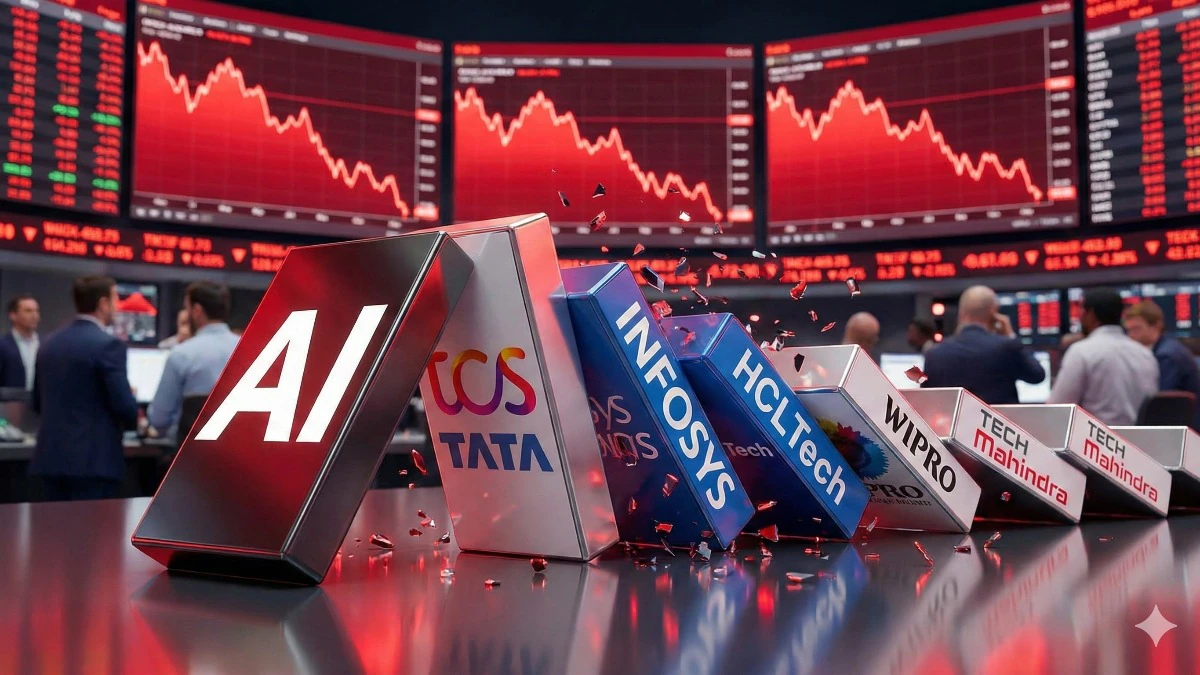
New Delhi, May 23: India’s leading technology companies are facing one of their toughest periods in recent years as weak global demand and the rapid rise of artificial intelligence continue to pressure growth.
Major software exporters including Infosys, Tata Consultancy Services (TCS), HCL Technologies and Tech Mahindra have witnessed a sharp decline in their stock values, with the sector losing nearly $115 billion in market capitalisation over the past four months.
The latest quarterly earnings from major firms have deepened investor concerns, signalling that the recovery may take longer than expected.
Weak Earnings Trigger Fresh Selloff
Investor sentiment weakened further after Infosys issued annual revenue growth guidance below market expectations. The company’s cautious outlook indicated that global clients remain hesitant to increase technology spending amid economic uncertainty.
HCL Technologies also disappointed investors after reporting lower-than-expected profits, leading to multiple analyst downgrades. Shares of both companies declined sharply following the announcements.
The broader NSE Nifty IT Index fell more than 5 per cent and has now dropped nearly 25 per cent in 2026, making it the worst-performing sector in the Indian market this year.
Global Economic Slowdown Hurting IT Spending
India’s IT industry depends heavily on clients from the United States and Europe. However, global economic uncertainty, inflation concerns and geopolitical tensions, including the Iran conflict, have caused companies worldwide to reduce discretionary spending.
Many businesses are delaying large digital transformation projects and avoiding long-term technology contracts until economic conditions become clearer. This slowdown has directly impacted India’s outsourcing companies, whose revenues rely on enterprise technology investments.
Analysts say clients are becoming increasingly cautious about committing large budgets due to uncertainty surrounding returns on investment and future business growth.
Artificial Intelligence Creating Structural Challenges
Apart from economic weakness, artificial intelligence has emerged as a major long-term challenge for India’s traditional outsourcing model.
For decades, Indian IT firms built their businesses around providing large teams of engineers for coding, software maintenance, customer support and back-office operations. AI-powered automation tools are now capable of performing many of these functions more efficiently and at lower costs.
This has raised concerns that demand for traditional outsourcing services could decline in the future.
Investors are closely monitoring how effectively Indian technology companies adapt to this transition. Companies are now trying to integrate AI into their services while also developing new AI-focused business opportunities.
IT Companies Shift Focus Towards AI
Infosys has started embedding AI solutions into its service offerings to improve productivity and reduce operational costs for clients. The company hopes that AI adoption will encourage businesses to continue investing in digital transformation projects.
Tata Consultancy Services has partnered with OpenAI to build AI data centres in India and is reportedly exploring additional collaborations with global technology firms.
Despite these initiatives, analysts believe markets want stronger evidence that AI investments can generate sustainable revenue growth before confidence in the sector returns.
Indian IT Sector Faces A Defining Moment
India’s software services industry first rose to global prominence during the late 1990s by helping international companies solve the Y2K crisis. Over the years, the sector successfully adapted to several technological shifts, including mobile computing, cloud technology and digital services.
However, experts believe the current AI revolution may represent a more significant transformation than previous technological changes.
The uncertainty has also affected investor confidence because many companies are unable to provide clear medium-term business forecasts.
Some Analysts See Long-Term Value
Despite the sharp decline in stock prices, some market experts believe valuations have become attractive after the selloff.
The IT sector index is currently trading at much lower valuation levels compared to previous years, prompting some investors to view the correction as a long-term buying opportunity.
Supporters of the sector argue that Indian IT companies still possess strong global client relationships, large engineering talent pools and decades of operational experience that could help them adapt successfully to the AI era.
Future Recovery Depends On Adaptation
The future of India’s technology sector now depends largely on how quickly companies can evolve their business models in response to AI-driven disruption and changing client expectations.
While the industry has survived multiple global crises and technology transitions in the past, experts say the coming years could determine whether Indian IT firms remain dominant global outsourcing leaders in the age of artificial intelligence.
