
India signs agreement with Australia to import uranium
The two countries also signed a new defence declaration, several technology pacts and a string of business and education deals.

New Delhi, July 9: India can now import Uranium for its civil nuclear plants from Australia as the two countries have reached an agreement to implement a bilateral deal signed way back in 2014.
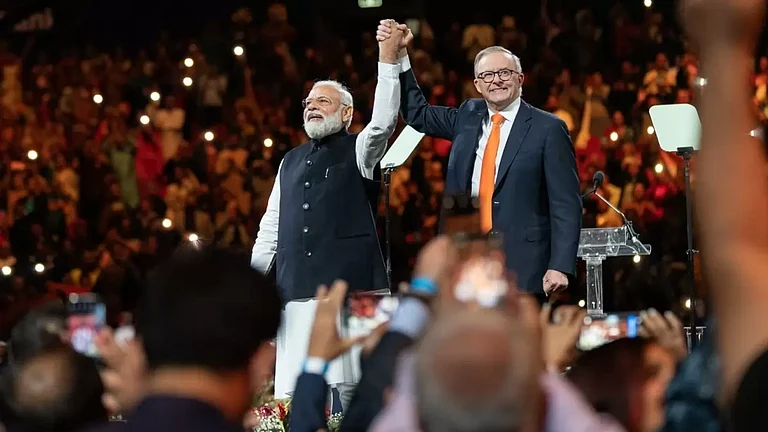
The announcement came as Prime Minister Narendra Modi held talks with his Australian counterpart Anthony Albanese in Melbourne.
The two countries also signed a new defence declaration, several technology pacts and a string of business and education deals.
“Today, we can confirm the signing of the Administrative Arrangement to enable uranium exports to India for peaceful purposes under the 2015 Australia-India Nuclear Cooperation Agreement,” Albanese told reporters at a joint press briefing.
He said the arrangement would help India “increase the share of non-fossil fuel power capacity” and open “an additional market for the Australian resources sector”.
Modi described it as an “important agreement” which would “open the path to uranium supply from Australia to India” and give India’s clean energy plans “new strength”.
A Joint Statement on Energy Security, issued after the Summit talks, said the two countries “have finalised the administrative arrangements necessary to enable the export of Australian uranium to India for exclusively peaceful purposes and under International Atomic Energy Agency safeguards, as provided for under the Australia-India Nuclear Cooperation Agreement (2015).”
However, there was no clarity as to when the imports can start.
Indian Foreign Secretary Vikram Misri, while briefing the media later, said “it had not been possible to operationalise” an administrative arrangement concluded earlier “because there was not an agreement fully on reporting-related issues” governing safeguarded uranium transfers.
Since uranium transfers would take place under International Atomic Energy Agency safeguards, India and Australia also needed a bilateral understanding on accounting and reporting procedures “that would satisfy both sides” and ensure that “the expectations of both sides with regard to the supply, the handling and the accounting and reporting of material were in place”.
“As a result of very intense discussions over a period of … almost two years, both sides were able to, to mutual satisfaction, conclude these issues,” he said.
The agreement signed on Thursday establishes that framework, after which commercial contracts can be negotiated for uranium supplies between Australian producers and their Indian counterparts.
This comes nearly 11 years after the two countries signed the Civil Nuclear Cooperation agreement in September 2014 during the visit of then Australian Prime Minister Tony Abbott’s visit to New Delhi, which had marked a reversal of Australia’s policy towards India on the nuclear issue.
The agreement had entered into force in November 2015.
Australia possesses the world’s largest known uranium reserves, accounting for nearly one-third of global reserves.
Its traditional policy, however, barred uranium sales to any country outside the Nuclear Non-Proliferation Treaty (NPT) since 1998.
India, a nuclear-armed country, has not signed the NPT. Despite that, it was granted a waiver by the Nuclear Suppliers Group (NSG) in September 2008 to conduct trade in civil nuclear field, making it the only nation outside NPT purview to be eligible.
Addressing an India-Australia business reception on Thursday, Modi said India has recently opened its nuclear sector to private participation through the SHANTI Act.
“Australia’s vast uranium reserves are directly linked to India’s nuclear journey,” Modi said, describing the sector as presenting a “historic opportunity” for bilateral cooperation.
In the separate joint statement on energy security, India and Australia shared “deep concern” over the consequences of the conflict for energy, resources and other commodity supply chains and prices.
The statement reaffirmed their commitment to maintaining stable energy trade, strengthening supply-chain resilience and accelerating the energy transition.
The two countries also launched the Australia-India Parternship on Cyber, Critical Technologies and Supply Chains, replacing the 2020 cyber cooperation framework with a broader mechanism covering cyber security, critical and emerging technologies, artificial intelligence, trusted supply chains, semiconductors, digital resilience and defence research.
Economic Cooperation Agreement
Modi said the two countries had decided to move quickly towards concluding a “balanced, ambitious and win-win” Comprehensive Economic Cooperation Agreement (CECA) and to advance negotiations on a bilateral investment treaty.
Misri said the two leaders had instructed officials to conclude the CECA “at the earliest possible” time.
Addressing business leaders before the summit, Albanese said Australia wanted its “business, ideas and expertise to help build and power and shape” India’s economic rise.
He announced that the Business Council of Australia would lead a senior business delegation to India during Australia Week later this year, while Austrade and the Australian high commission in New Delhi would convene a new investment roundtable in Mumbai.
Albanese also confirmed a refreshed memorandum of understanding between Geoscience Australia and the Geological Survey of India on critical minerals.
The Indian PM argued that geopolitical uncertainty had strengthened the case for closer commercial ties.
“Today the world is passing through a period of uncertainty, supply chain disruption and energy crisis. At such a time, it is natural and necessary for India and Australia to move forward as natural and trusted partners,” he said.
The summit also broadened cooperation in science, technology and education.
Albanese announced that Australia and India would commission a temporary space tracking terminal on the Cocos (Keeling) Islands to support India’s Gaganyaan human spaceflight programme, while the two countries also welcomed a trilateral technology partnership with Canada covering critical and emerging technologies. (BVI)
