
Further progress on Mumbai-Ahmedabad Bullet Train project

By Arun Kumar Das
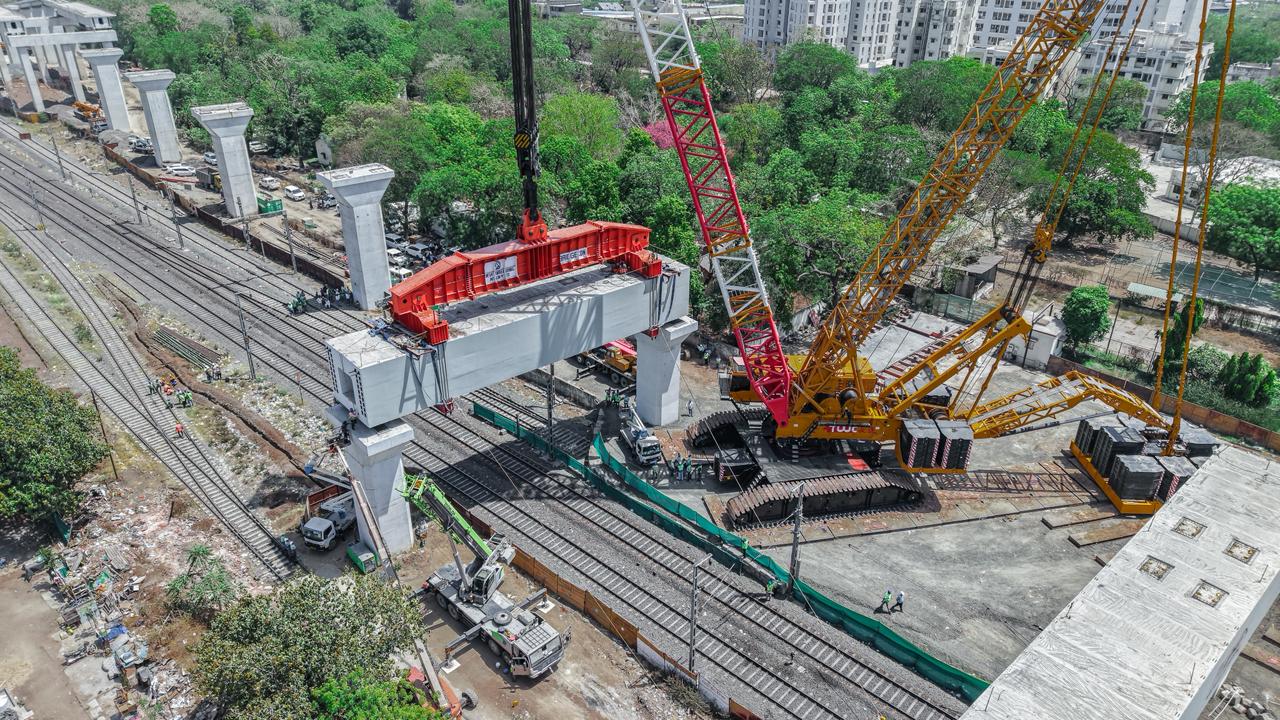
New Delhi, May 5: In further progress on the Mumbai-Ahmedabad Bullet Train project, engineers have successfully installed all the five precast-prestressed heavy portal beams or girders on the railway line between Ahmedabad and Vadodara, marking a significant milestone.
These girders have been launched within just 22 days through exceptional coordination, speed, and execution, according to the Railway officials involved in the ambitious project to establish the country’s first top-speed train service.
The heaviest beam, weighing approximately 1360 MT, was launched on 8th April 2026, marking one of the heaviest lifts ever undertaken over operational railway lines.
Each of the five beams weighed between 1170 MT and 1360 MT, making this one of the most complex structural operations executed on railway infrastructure.
At Maninagar, the Bullet Train alignment crosses over existing railway tracks at an elevated level with a skewed and constrained geometry, requiring careful structural planning.
The space between the two piers is also relatively large (around 30 m to 34 m), which further demands a strong and rigid supporting system like portal beams to safely transfer loads.
The portal beams at this location have been designed as heavy structures to span across multiple active Indian Railways tracks, including the Amdavad–Vadodara UP, Down, and third lines.
Their large size and weight provide enhanced stability and minimal deflection, which is essential for maintaining precise track alignment and ensuring safe operations over such a busy railway track.
The launching activity was carried out using a 2200 MT crawler crane as the primary equipment which is used for the first time in India over Indian railway tracks.
Each portal beam was launched in just about 3.5 hours which is significantly faster than the earlier 9-hour blocks and in close coordination with Indian Railways.
Despite challenges like limited space, OHE (over-head electrification) and active railway tracks, the operation was executed with high precision, strict safety checks, and continuous monitoring.
