
First double-stack long-haul container train on track

By Arun Kumar Das
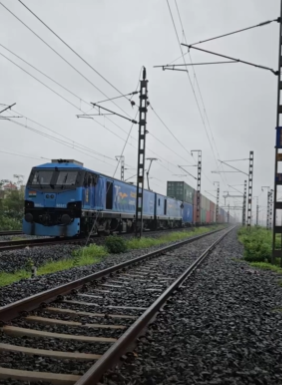
New Delhi: Indian Railways has successfully operated its first double-stack long-haul container train from Jawaharlal Nehru Port Trust (JNPT) in Mumbai to CONCOR’s Goods Cargo Terminal (GCT) at Varnama in Vadodara Division, carrying 360 TEUs (Twenty-foot Equivalent Units) in a single movement.
The long-haul formation comprised two double-stack rakes. The leading rake carried 45+1 loads and was hauled by locomotive number 60311, with a tonnage of 1,817 tonnes.
The trailing rake also carried 45+1 loads and was hauled by locomotive number 24690, with a tonnage of 2,105 tonnes, according to the Railways.
Together, the two rakes transported 360 TEUs, demonstrating Indian Railways’ ability to move larger volumes of containerised freight through long-haul operations.
The Railways said the initiative could help reduce congestion at ports and terminals by enabling faster evacuation of containers.
Double-stack container trains can also reduce the requirement for rolling stock, improve utilisation of existing route capacity and speed up freight movement.
The operation is expected to enhance freight-carrying capacity while helping reduce transportation costs, the Railways said.
The movement of a larger number of containers in a single train will help reduce the dwelling time of containers at ports and terminals, thereby minimising terminal congestion and facilitating faster evacuation.
Double-stack operations enable more containers to be transported in a single movement, reducing the requirement for locomotives and container flat wagons for handling the equivalent freight volume.
Carrying more containers in a single train reduces the number of train movements required to transport the same volume of freight, thereby enabling better utilisation of available route capacity. Long-haul container train operations facilitate faster movement and evacuation of containers, contributing to reduction in the overall transit time of freight.
The operation also underlines Indian Railways’ commitment towards green and sustainable freight transportation. Being an electrically hauled train, the movement reduces dependence on diesel-powered road transportation.
A single long-haul double-stack container train can transport cargo equivalent to that requiring a large number of trucks by road. This helps reduce diesel consumption, road congestion, vehicular emissions and the overall carbon footprint of freight transportation. (BVI)
