
PM flags off ‘E VITARA’, Suzuki’s first Made-in-India Battery vehicle

By Arun Kumar Das
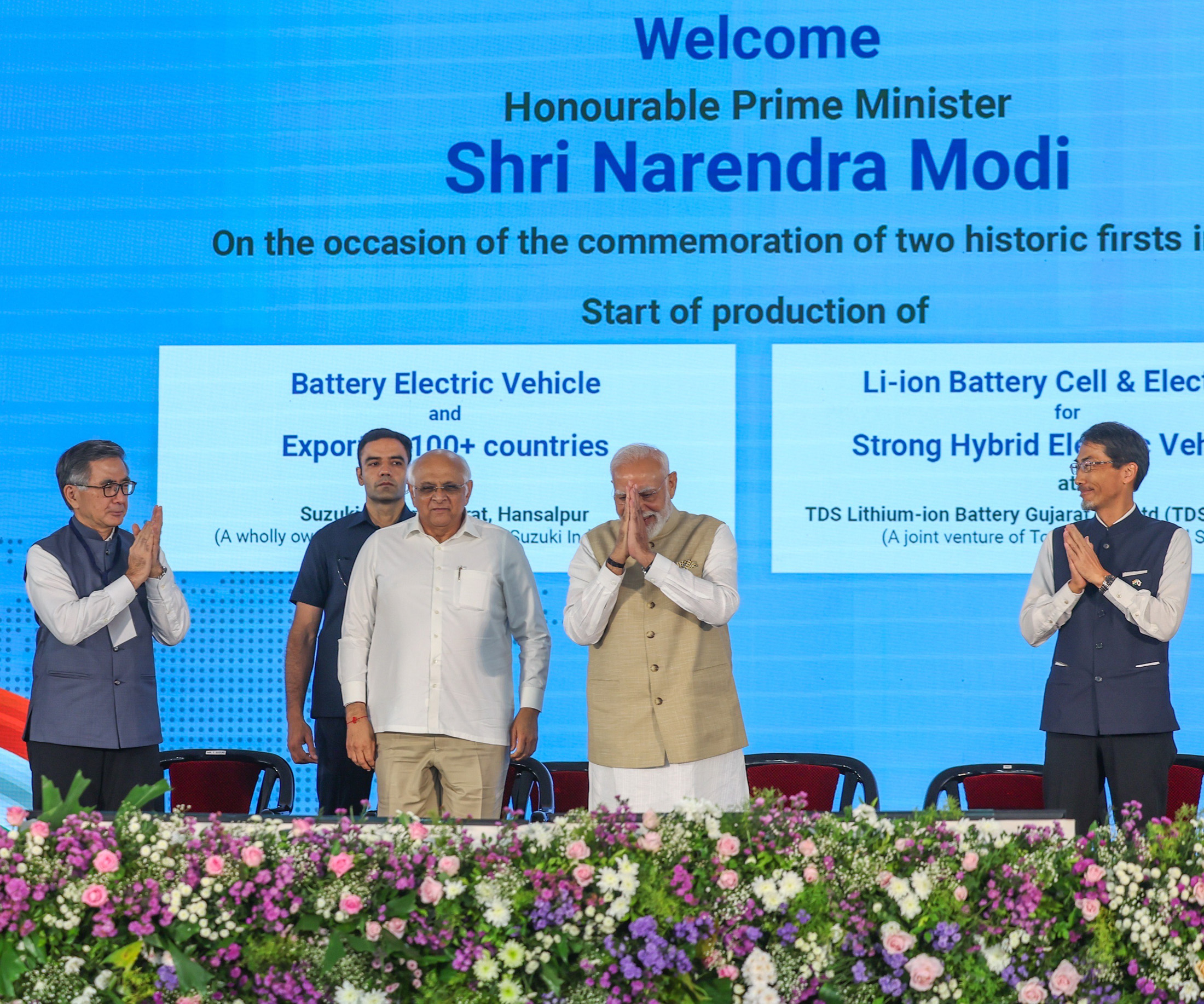
New Delhi, Aug 26 (BVI): Prime Minister Narendra Modi today inaugurated the green mobility initiatives in Hansalpur in Gujarat as part of the government’s endeavour to become Aatmanirbhar in the field of clean energy.
He inaugurated and flagged off the ‘E VITARA’, Suzuki’s first global strategic Battery Electric Vehicle (BEV) which will be exported to more than 100 countries, including advanced markets such as Europe and Japan.
With this milestone, India will now serve as Suzuki’s global manufacturing hub for electric vehicles.
The Prime Minister also inaugurated the next phase of India’s battery ecosystem with the start of local production of hybrid battery electrodes at TDS Lithium-Ion Battery plant in Gujarat.
The plant, a joint venture of Toshiba, Denso and Suzuki, will boost domestic manufacturing and clean energy innovation.
This development ensures that more than eighty percent of the battery value will now be manufactured within India.
Addressing the gathering after the inauguration, he noted that amid the festive spirit of Ganesh Utsav, today’s development marks a significant leap towards the shared goal of “Make-in-India, Make-for-the-World.”
Modi said that from today, electric vehicles manufactured in India will be exported to 100 countries. He further announced the commencement of Hybrid Battery Electrode manufacturing in the country.
Modi recalled that the land for the project was allotted to Maruti Suzuki in Hansalpur in 2012 when he was the Chief Minister of Gujarat.
Even at that time, the vision was of Aatmanirbhar Bharat and Make in India, he said and added that those early efforts are now playing a significant role in fulfilling the nation’s current resolutions.
The Prime Minister pointed out that Suzuki Japan is manufacturing in India, and the vehicles produced here are being exported back to Japan.
This reflects not only the strength of India-Japan relations but also the growing trust of global companies in India, he added.
He stated that companies like Maruti Suzuki have effectively become brand ambassadors of Make in India. Noting
Underlining that the most critical component of the EV ecosystem is the battery, the Prime Minister said that until a few years ago, batteries in India were entirely imported.
He added that to strengthen EV manufacturing, it was essential for India to begin domestic battery production.
Mentioning that until a few years ago, EVs were viewed merely as an alternative option, the Prime Minister emphasized his belief that EVs offer concrete solutions to multiple challenges.
He recalled that during his visit to Singapore last year, he had proposed converting old vehicles and ambulances into hybrid EVs. Shri Modi commended Maruti Suzuki for accepting this challenge and developing a working prototype within just six months.
He shared that he personally reviewed the prototype of the hybrid ambulance and said that these hybrid ambulances align perfectly with the PM E-DRIVE scheme.
The Prime Minister noted that under this ₹11,000 crore scheme, a dedicated budget has been allocated for e-ambulances.
He highlighted that hybrid EVs will help reduce pollution and offer a viable option to transform old vehicles.
Affirming that clean energy and clean mobility represent the future of India, Shri Modi emphasized that through such efforts, India is rapidly emerging as a reliable hub for clean energy and clean mobility.
The Prime Minister noted that at a time when the world is grappling with supply chain disruptions, India’s policy decisions over the past decade are proving highly effective.
Recalling that in 2014, upon receiving the opportunity to serve the nation, preparations for this transformation were initiated, the Prime Minister highlighted the launch of the Make in India campaign and the creation of a conducive environment for both global and domestic manufacturers.
The Prime Minister announced that he will be visiting Japan next week, emphasising that the relationship between India and Japan goes far beyond diplomatic ties—it is rooted in culture and mutual trust. (BVI)
