
Historic Milestone: First Freight Train reaches Kashmir from outside Valley

By Arun Kumar Das
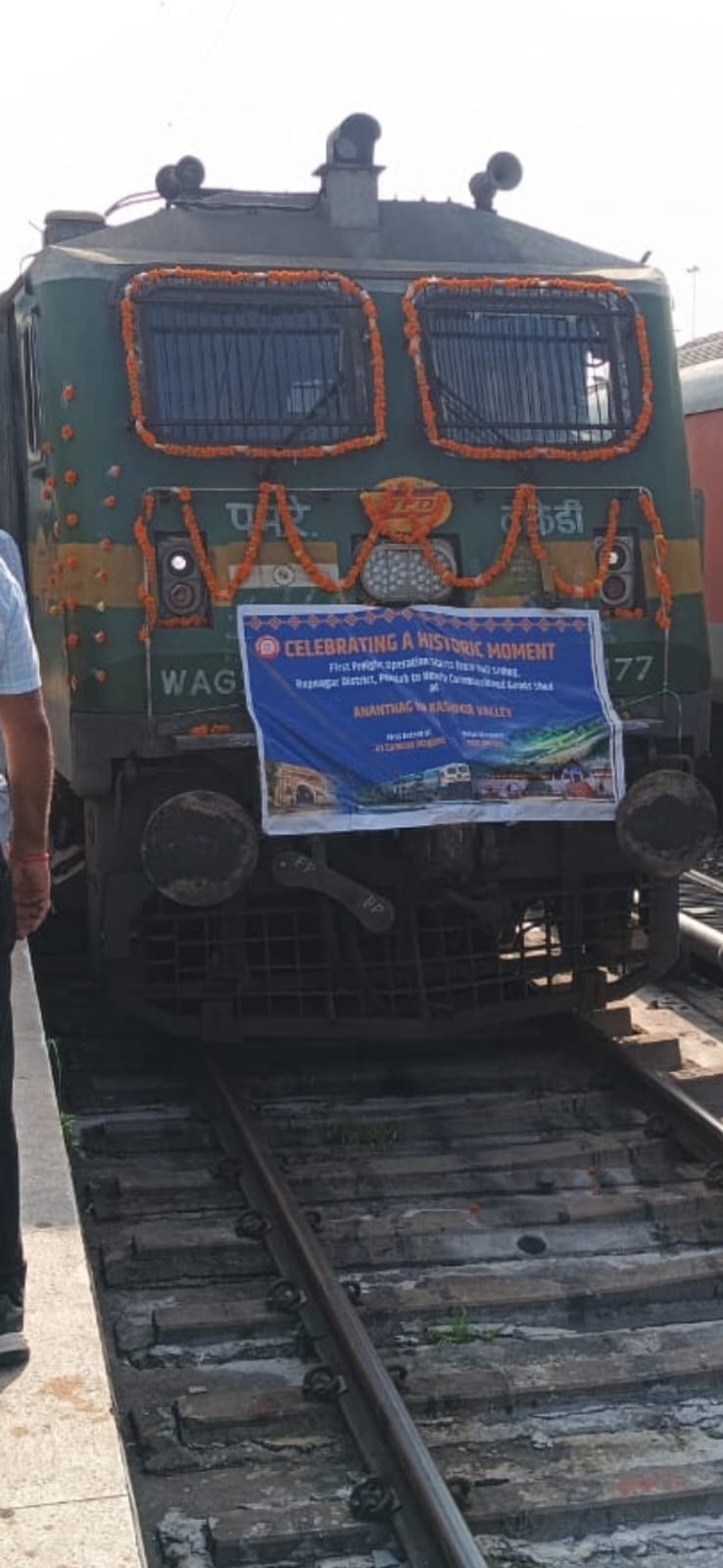
NEW DELHI, Aug 9 (BVI) In a historic milestone, the first goods-carrying train today reached the newly-commissioned Anantnag goods shed in the Kashmir from Punjab, marking the Valley’s integration with the freight network of rest of the country.
This connectivity will reduce transportation costs for citizens and open new avenues for trade.
The first freight train from outside the Kashmir Valley reached Anantnag more than two months after this rail line was inaugurated by Prime Minister Narendra Modi.
On June 6, Modi inaugurated the 63-km Katra-Sangaldan section of USBRL and flagged-off a specially designed Vande Bharats running between Srinagar and Katra, marking the completion of a project to link Kashmir to the rest of the country, which was first initiated 42 years ago.
This freight connectivity is expected to transform the economic landscape of the Kashmir Valley, giving a strong push to its agricultural, handicraft, and floriculture sectors.
Hailing the development, Prime Minister Narendra Modi said: “Great day for commerce and connectivity in Jammu and Kashmir! It will enhance both progress and prosperity.”
The arrival of freight trains, carrying cement, is set to accelerate infrastructure projects and improve living standards for the people of Kashmir.
The inaugural freight train was loaded with 21 wagons of cement.
The journey, spanning approximately 600 kilometers, culminated at the newly commissioned Anantnag Goods Shed today in less than 18 hours. This event marks the first-ever cement loading specifically for this facility, underscoring its readiness to support a new era of logistical and economic growth in the Kashmir region.
The cement transported on this train will be used for crucial projects, including the construction of roads, bridges, public infrastructure, and residential housing in the Kashmir Valley.
The logistics for this groundbreaking journey were executed with precision. An indent was placed with Northern Railway at 12 PM on August 7, 2025, with the train departing from the Gujarat Ambuja Cement Limited (GACL) facility in Rupnagar, Punjab at 6.55 Pm on August 8.
The freight was hauled by an Electric locomotive highlighting the modern capabilities of the national railway network.
The arrival of this first freight train is not just a logistical achievement but a powerful symbol of progress and integration, paving the way for a more connected and prosperous Kashmir Valley.
The new goods train link will enable Kashmir’s renowned products to reach markets across India and the world more efficiently, creating new business and export opportunities.
Officials said that the freight train was loaded with 1380 metric tonnes (MT) cement in Bogie Covered wagon or BCN wagon, which is used for carrying bagged commodities. The order for the cement was placed by private entities involved in different construction projects.
The 272-km USBRL is divided into three parts: 25-km Udhampur-Katra, 111-km Katra-Banihal and 136-km Banihal-Baramulla. The two sections Udhampur-Katra in Jammu and Banihal-Baramulla in Kashmir was constructed by Northern Railway, the biggest zone of Indian Railways, and was made operational in three phases- 118-km Qazigund-Baramulla in 2009, 18-km Banihal-Qazigund in 2013 and 25-km Udhampur-Katra in 2014.
The trickiest stretch was the Katra-Banihal section, totalling 111 km. This includes India’s longest operational transportation tunnel, T-50, running to 12.77 km; the world’s highest railway arch bridge at 359 metres above the sea floor (the Chenab Bridge); and the first cable-stayed bridge of the Railways (the Anji Bridge).
Currently, Vande Bharat is running from Katra to Srinagar and local trains are operational in the USBRL’s 184-km stretch between Sangaldan in Jammu’s Ramban district and Kashmir’s Baramulla.
Major products with strong domestic & export potential include:
• Fruits & Dry Fruits: Apples (Red/Golden Delicious, Ambri), walnuts, almonds, apricots, pears, cherries, plums, grapes, hazelnuts, mulberries.
• Flowers & Floriculture: Saffron (GI-tagged), lavender, roses, marigold, tulips.
• Handicrafts: Pashmina shawls (GI-tagged), silk/wool carpets, papier-mâché, walnut wood carving, Namda rugs, Sozni embroidery, chainstitch wall hangings.
• Spices & Specialty Crops: Kashmiri red chillies, garam masala, fennel seeds, cumin seeds.
• Beverages & Processed Foods: Kahwa tea, apple juice & cider, apricot kernel oil, walnut oil.
• Honey & Herbal Products: Mountain honey, medicinal herbs, essential oils.
• Tourism Souvenirs: Miniature houseboats, Kangri warmers, copperware samovars.
Export Outlook:
• GI-tag products like Kashmiri saffron and Pashmina have strong global appeal.
• Established export channels for apples, walnuts, and almonds can be expanded with value-added products.
• Floriculture and essential oils hold high-value demand in Europe, Middle East, and Japan.
• Handicrafts can leverage e-commerce ands torytelling for wider reach. (BVI)
