

By Arun Kumar Das
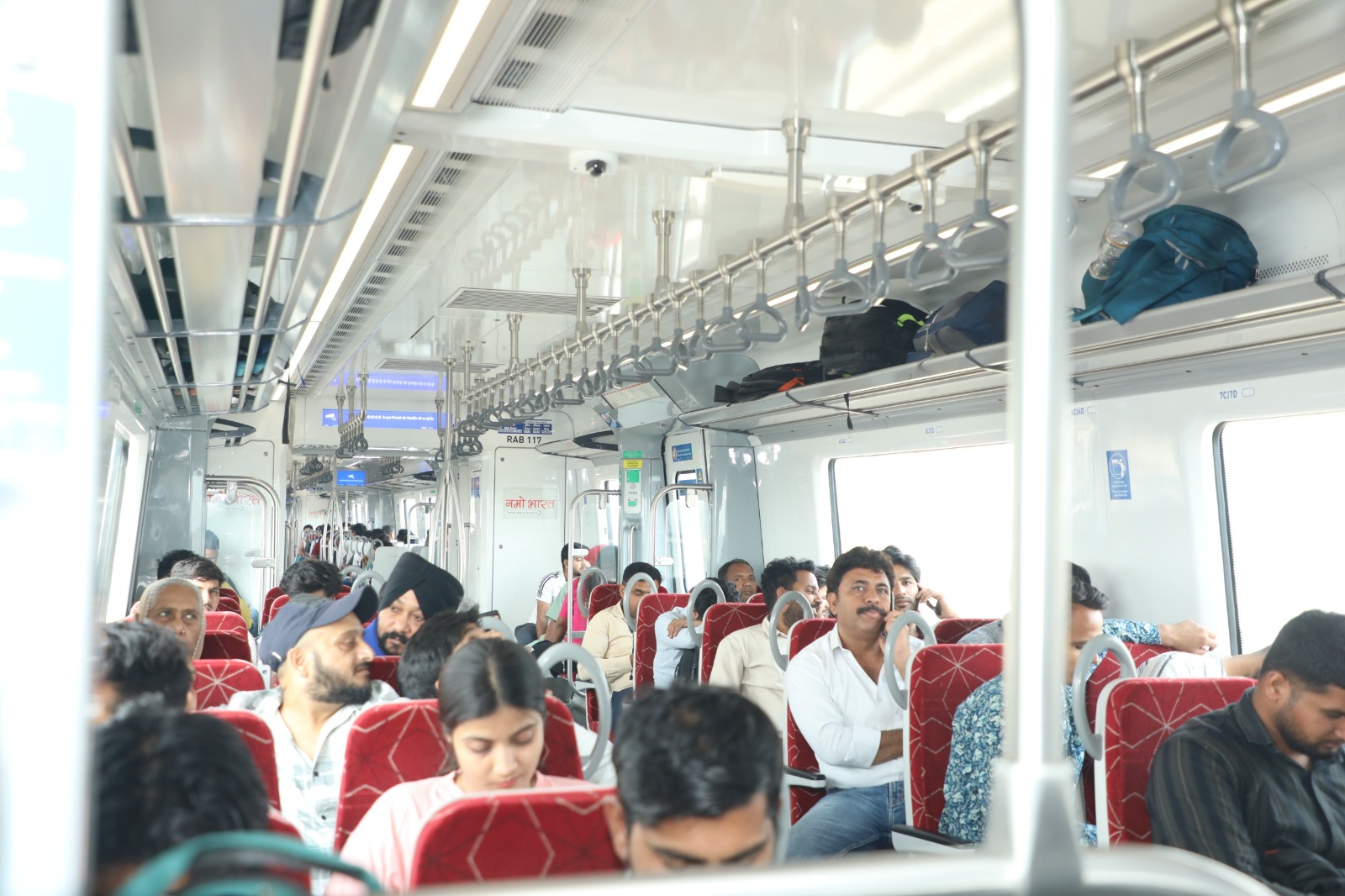
New Delhi, May 5: The Delhi-Meerut Namo Bharat train service has crossed 3 crore passenger journeys within months of the commissioning of the full corridor, marking a major milestone for new-age regional transit in the National Capital Region (NCR).
Over the past two years, it has steadily built commuter trust, now clearly reflected in the steady rise in ridership and more and more people are choosing it as a fast, safe, and comfortable way to travel.
On 22 February 2026, the Prime Minister dedicated the entire Delhi-Ghaziabad- Meerut Namo Bharat corridor, along with Meerut Metro, to the nation. Since then, ridership has been rising steadily.
Apart from Sundays, which see around 85,000 passengers, daily footfall on weekdays ranges between 90,000 and 1,14,000.
Operations on the corridor first began on October 21, 2023 with the inauguration of a 17-km Priority Section between Sahibabad and Duhai Depot.
In November 2023, after the first full month of operations, the section recorded a ridership of over 72,000.
As services were extended to Modinagar North in March 2024 and further to Meerut South in August 2024, the operational section expanded to 42 km with nine stations. With each extension, ridership kept steadily rising.
By December 2024, average monthly ridership numbers had reached about 7 lakhs, nearly ten times higher than the same period a year earlier.
A major boost came in January 2025, when an additional 13-km Delhi section from New Ashok Nagar to Sahibabad became operational.
With the commissioning of this section, stations like Anand Vihar, developed as a key multi-modal hub, made access easier for a much larger set of commuters.
This helped bring in passengers not just from nearby areas but from across Delhi and adjoining regions.
On 16th May 2025, a major milestone was achieved when the ridership hit the record of 1 crore. By July 2025, average monthly ridership had reached close to 15 lakhs, more than double compared to just six months earlier.
Around the same time, daily ridership stabilised at about 55,000–60,000.
To handle the growing demand, train frequency was increased from every 15 minutes to 10 minutes, with the system designed to go up to every 3 minutes when required.
In December 2025, Namo Bharat crossed the milestone of 2 crore commuter trips.
On February 22, the remaining 26 km section of the corridor, along with Meerut Metro, was commissioned, marking the operations of the entire corridor and the ridership picked up even faster.
Within a month, Namo Bharat emerged as a preferred mode of regional travel and in *March 2026* alone, monthly ridership reached around 27 lakhs.
What stands out is the pace of growth, Namo Bharat crossed the milestone of 3 crore commuter trips in less than five months of reaching 2 crore journeys.
One of the key reasons behind this shift is the significant saving in travel time where Namo Bharat has reduced the commute time to one-third.
What used to take nearly three hours by road between Delhi and Meerut can now be covered in about one hour.
This time advantage, along with predictable journey durations, has made Namo Bharat a practical choice for daily commuters as well as those travelling for work, education, healthcare, leisure and other needs.
Apart from speed, several initiatives taken by NCRTC have made the overall travel experience smoother.
Commuters can use the Namo Bharat Connect app for QR-based ticketing and real-time train tracking, reducing the need to queue at stations.
Digital integration with the mobile applications of DMRC and IRCTC has enabled end-to-end journey planning between Delhi Metro, Namo Bharat and railways.
At New Ashok Nagar, a single-point security check between Namo Bharat and Delhi Metro has further simplified interchanges, saving time and making transfers more seamless.
Efforts have also been made to strengthen first- and last-mile connectivity. Integration with DEVI buses in Delhi and UPSRTC buses in Ghaziabad, Delhi Metro, and feeder options like e-autos is helping commuters easily reach stations and complete their journeys.
Namo Bharat stations like Sarai Kale Khan, Anand Vihar, New Ashok Nagar and Ghaziabad provide seamless connectivity with Delhi Metro, extending its 82 km corridor to 390 kms of operational Delhi Metro network and enabling wider access across the NCR.
Sarai Kale Khan, and Anand Vihar are also emerging as important Multimodal hubs, connecting multiple modes of transport.
Namo Bharat is also designed as a safe and inclusive mode of travel. Features such as 24/7 CCTV surveillance, dedicated women coach, SOS buttons, well-lit stations, and the presence of trained staff help ensure a secure transit environment.
Awareness initiatives and campaigns have further supported this effort, encouraging more women to use the system with confidence.
Importantly, Namo Bharat has maintained consistent performance even during peak demand, extreme heat, monsoon conditions, and festive periods such as Kanwar Yatra and Diwali.
With train operations maintaining around 99% punctuality, commuters can rely on the system to reach their destinations on time, avoiding road congestion and uncertainty.
This steady rise in ridership points to a broader shift in how people are travelling across NCR. Namo Bharat is no longer just an alternative, it is becoming a dependable part of daily life for a wide range of commuters.
