

By Arun Kumar Das
New Delhi, Feb 11 (BVI): Indian Railways has taken a new step towards improving freight transportation.
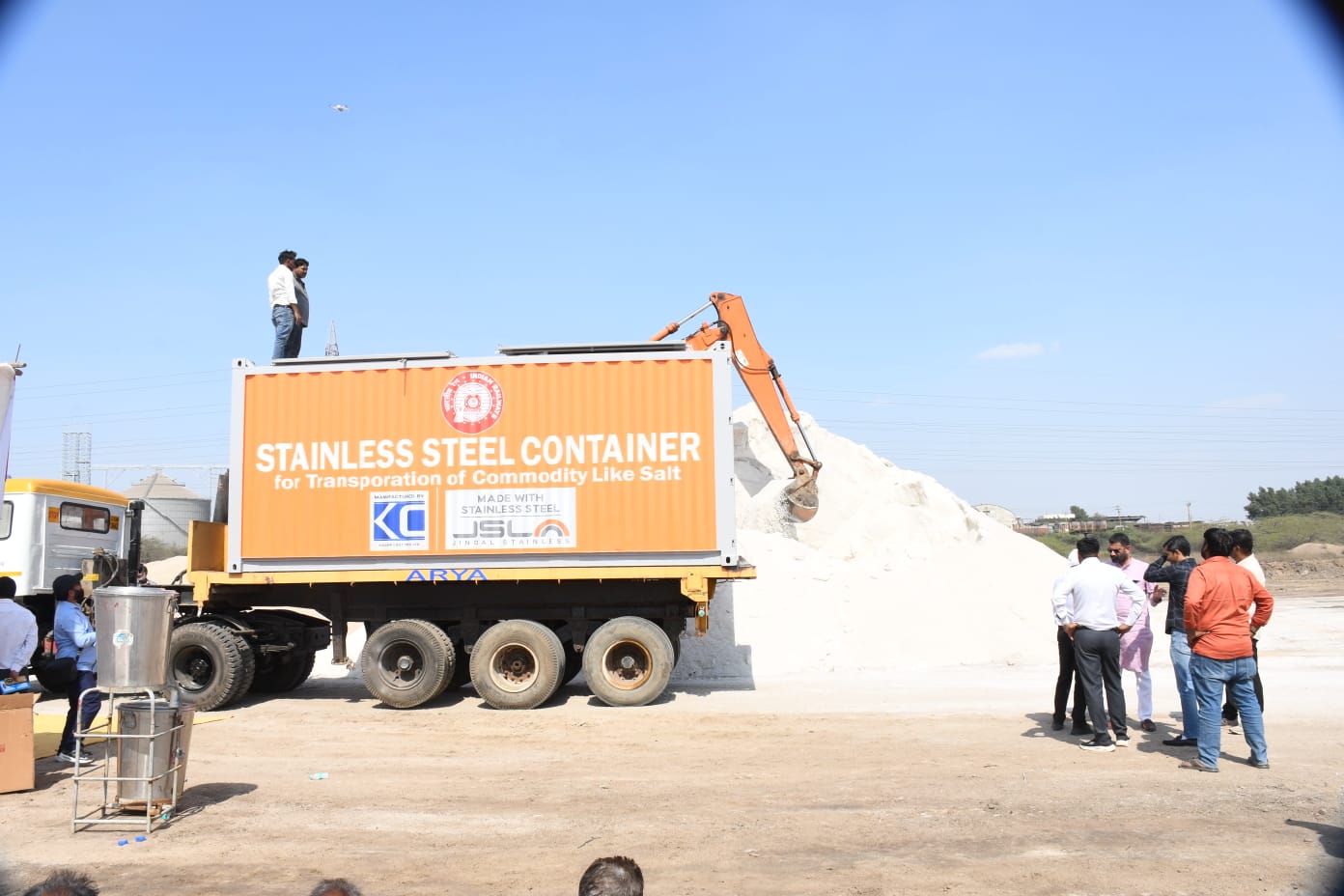
Under the Ahmedabad Division, for the first time, a successful trial was conducted using stainless steel containers for the transportation of salt in the Bhimasar-Gandhidham section.
These containers have been specially designed for the transportation of salt and other corrosive bulk materials.
As they are made of stainless steel, the problem of corrosion is significantly reduced.
This enhances the durability of the containers and ensures the safety of the cargo inside.
In addition, cleaning and maintenance of these containers require less effort and lower expenditure.
In order to enable faster loading, the containers are provided with two large openings of size 7 × 4 feet on the top.
Through these openings, salt can be directly loaded using a silo system or poured from the top with the help of a Porcelain machine.
This makes the loading process quicker and more convenient.
During the trial, it was observed that salt could be loaded into one container in less than 15 minutes.
This method proved to be significantly faster compared to conventional practices. Unloading was found to be equally efficient.
Using a hydraulic tipper truck, the container was tilted, and the entire salt was discharged in less than 5 minutes.
The side doors provided in the container allow the salt to flow out automatically, leaving no residue behind and eliminating the need for cleaning.
The tare weight of one stainless steel container is approximately 3 tonnes.
Two containers can be placed on one wagon, enabling the transportation of up to 68.4 tonnes of salt per wagon.
This capacity is comparable to conventional wagons.
A full rake of 48 wagons can carry approximately 3,300 tonnes of salt.
This enables large-scale transportation of salt in a timely and efficient manner.
The use of these containers eliminates the requirement of manual wagon cleaning.
There is also no need for tarpaulin covering or any coating.
Faster loading and unloading reduce wagon turnaround time, enabling quicker operations and improved efficiency.
Moreover, since the containers are enclosed, the possibility of moisture ingress, contamination, or adulteration in salt is significantly reduced.
This ensures better cargo quality for customers and further strengthens the reliability of Indian Railways.
This initiative opens new opportunities for the future transportation of other corrosive and bulk commodities.
Overall, this trial marks a major achievement for Indian Railways. It will also strengthen Indian Railways’ progress towards a modern, safe, and reliable logistics system. (BVI)
