
Railways speeds up Kavach 4.0 safety rollout, 472 km-track done

By Arun Kumar Das
New Delhi, Jan 31 (BVI) :Indian Railways has successfully commissioned Kavach 4.0 on the 35-km Tughlaqabad Junction Cabin–Palwal section of the four-line Delhi–Mumbai route, which spans 152 main line track kilometres, the highest-ever Kavach commissioning achieved in a single day.
Kavach, the anti-train collision system, has been installed in a complete stretch of this corridor comprising major station yards, two main lines with automatic signaling system and two lines with absolute block signalling, according to railway officials.
This commissioning marks a significant safety upgrade on one of the busiest and high-density corridors of the Indian Railways covering Delhi suburban and long-distance rail network, they said.
This section is a high-traffic stretch catering to passenger, suburban, and freight trains. Commissioning of Kavach on this section significantly enhances operational safety, reliability, and passenger confidence.
Indian Railways has also commenced train operations with Kavach 4.0 on the 93.3 km Manpur–Sarmatanr section of the DDUGJ–Pt. Deen Dayal Upadhyaya division.
The first Kavach-enabled service, Sasaram Intercity Express, operated successfully on this section, departing Sone Nagar at 07:42 hrs and arriving at Manpur at 09:35 hrs.
During the run, a head-on collision test was conducted, in which the train automatically stopped, validating the system’s effectiveness.
Kavach is being installed over 4,235 route kilometres of East Central Railway, including 417 route kilometres on the Pt. Deen Dayal Upadhyaya Junction–Manpur section, a critical part of the Delhi–Howrah trunk route passing through Uttar Pradesh, Bihar, and Jharkhand.
The section carries mixed traffic and is currently cleared for 130 kmph, with works in progress under Mission Raftar to enhance the speed potential to 160 kmph.
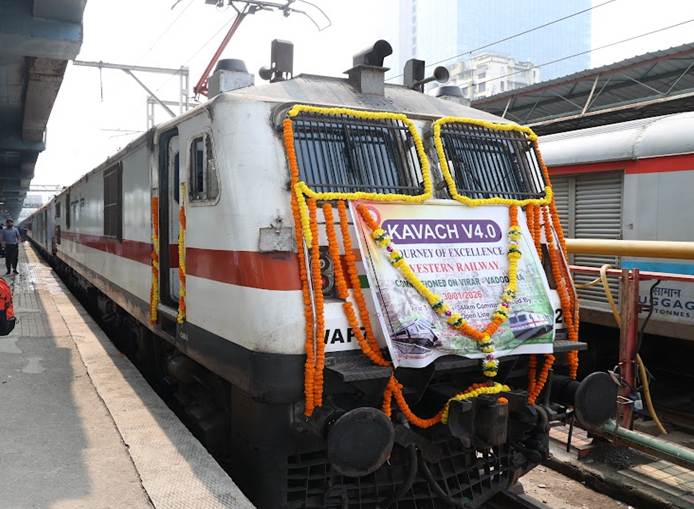
Work on the Vadodara–Surat–Virar section on Delhi-Mumbai route commenced in January 2023, and on 30 January 2026, Kavach has been successfully commissioned on this 344-km section. This historic milestone was achieved with Train No. 20907, Dadar–Bhuj Sayajinagri Express, becoming the first KAVACH equipped train to run from Mumbai.
Work on the Vadodara–Nagda section is progressing at a fast pace and is expected to be commissioned by March 2026, while work on the Virar–Mumbai Central section is also progressing well and is targeted for completion by September 2026.
Simultaneously, Kavach installation on locomotives is advancing steadily, with 364 locomotives on Western Railway equipped with Kavach so far.
In addition, works on several other sections of Western Railway have been sanctioned, covering a total of 2,667 Route Kilometres, with execution underway on all sanctioned sections.
Kavach Version 4.0, the latest and most advanced iteration of India’s indigenous Automatic Train Protection system, has been developed through continuous technological upgrades based on operational feedback and independent safety assessments.
Approved by the Research Designs and Standards Organisation (RDSO), Kavach 4.0 represents a major advancement in railway safety.
It is specifically designed to address the operational demands of India’s diverse, high-density and multi-line rail network, offering enhanced reliability, faster response, and seamless integration with existing signalling and interlocking systems.
Certified by an Independent Safety Assessor (ISA) to meet global safety standards, Kavach 4.0 is fully equipped for large-scale deployment across Indian Railways.
Kavach integrates microprocessors, Global Positioning System (GPS), and radio communication technologies to ensure safe train operations.
When another train is detected on the same track within a predefined distance, the system alerts the locomotive pilot and, if required, automatically applies brakes through onboard equipment.
Kavach provides automatic protection against Signal Passing at Danger (SPAD) and effectively prevents side, head-on, and rear-end collisions. It also continuously monitors and controls over speeding, ensuring safe operations even under low visibility and adverse weather conditions.
In addition, the system generates alerts during wrong-direction and reverse movements and provides automatic information on level crossing gates.
Kavach complies with SIL-4 safety standards, the highest level of safety integrity globally. Being an indigenously designed and cost-effective system, it reduces dependence on imported technologies and promotes Indian signaling industry.
Indian Railways is progressively expanding Kavach coverage, reinforcing its commitment to safe and reliable train operations and safer rail travel for millions of passengers.
This commissioning is another step in commitment towards a safer, smarter, and self-reliant Indian Railways. (BVI)
