

By Arun Kumar Das
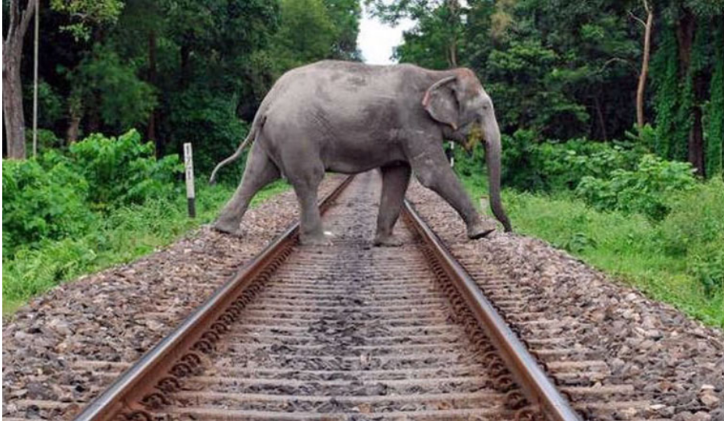
BINNAGURI (New Jalpaiguri), Jan 20 (BVI): It was 6.36 AM, a foggy winter morning and there was little bit of commotion at the Station Superintendent office as an elephant was detected by the track detection system installed in the room.
There were a flurry of calls to nearby stations and Level Crossing gates along the New Jalpaiguri – Alipurduar route.
The entire 155 km long route in North Bengal is now on alert mode with the train movement being restricted to 25 km per hour as a precautionary move.
However, the elephant remained on the track side for just 45 seconds and disappeared into the nearby thick forest and it was all clear for regular movement of goods and passenger trains.
“We keep extra vigil on the route from 5 pm to 6 AM daily because this is the period when elephants keep crossing tracks,” said SK Sunil, Station Superintendent.
“The train speed is restricted to 25 km during this time and it is mandatory for the loco pilots to slow down the train movement in this particular stretch during this time. If any movement is detected then drivers of all incoming trains, station masters of all stations and Level Crossing Gateman are immediately informed,” Sunil said.
The route also known as elephant corridor because of the frequent movement of the elephants along the tracks is a sensitive one.
Just a few years ago, this Banarhat and Caron section had witnessed killing of 6 elephants on the tracks in 2016-17. But now the Railways has made an elaborate arrangement with the installation of an elephant detection system to prevent animal runover on the tracks.
Installed by Bitcom, the Intrusion Detection System (IDS), seems to be working fine in the region as there have been no such elephant runovers on the tracks since then.
The intrusion detection System (IDS) is a fiber based system worked on the principle of Distributed Acoustic Sensing (DAS). Optical fibers are being laid along the tracks for getting sensor-based signals at the monitoring centers in stations.
Explaining the system, Irfan Azam, the senior Section Engineer, who is part of the IDS installation program said the detection/classification/location of events is based on the quantitative measurement of Rayleigh backscatter and the time delay between transmitted pulse and received backscatter.
The system is being developed with lots of trials and measurements after closely following elephant movement in the region. Everything is taken into account including the weight of the elephant, the duration between one step of the elephant to the next step and all other necessary factors.
Irfan further said the IDS works on the sensor system. The sensor detects the elephant from its weight and sends alarm signals to the monitoring machine installed at the stations. There are 10 such stations along the route which have the IDS operational.
The hooter system at the LC gate and honeybee sound system get activated as an additional step once the elephant is detected on the tracks, said Irfan.
Accidents used to happen earlier when there was no IDS here and also no speed restriction in force for the train operation. But after the installation of the IDS, the number of accidents have reduced, said Sunil.
Sunil said “We get sensor-based alarms 3 to 4 times in a day but the crucial period was during the night time when we have to be extra cautious.”
In order to make the system broad-based the Railways is now planning to install the system in the forest also to keep a close tab on the movement of elephants.
We get regular information about the elephant movement from the forest department and we coordinate with them to prevent any possible mishaps on the track, said Irfan.
About getting a false alarm, Irfan said the system gets calibrated periodically to prevent false alarms. Since optical fiber is being laid within 20 meters from the track, the sensor detects elephant movement near the tracks.
Currently, the system is operational in 47 km of the 155 km long section. This 47 km is the most vulnerable section in the region and the area is being selected for system installation after closely monitoring elephant movement in the nearby forest. (BVI)
