
Cabinet approves Export Promotion Mission

By Arun Kumar Das
New Delhi, Nov 12 (BVI): The Centre today approved the Export Promotion Mission (EPM) — a flagship initiative announced in the Union Budget 2025–26 to strengthen India’s export competitiveness, particularly for MSMEs, first-time exporters, and labour-intensive sectors.
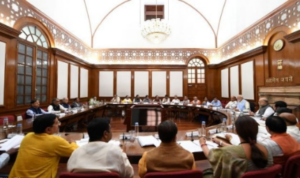
The Cabinet, at a meeting chaired by Prime Minister Narendra Modi, approved the Mission which will provide a comprehensive, flexible, and digitally driven framework for export promotion, with a total outlay of Rs.25,060 crore for FY 2025–26 to FY 2030–31.
EPM marks a strategic shift from multiple fragmented schemes to a single, outcome-based, and adaptive mechanism that can respond swiftly to global trade challenges and evolving exporter needs.
EPM is anchored in a collaborative framework involving the Department of Commerce, Ministry of MSME, Ministry of Finance, and other key stakeholders including Financial Institutions, Export Promotion Councils, Commodity Boards, industry associations, and state governments.
The Mission will operate through two integrated sub-schemes:
NIRYAT PROTSAHAN – focuses on improving access to affordable trade finance for MSMEs through a range of instruments such as interest subvention, export factoring, collateral guarantees, credit cards for e-commerce exporters, and credit enhancement support for diversification into new markets.
NIRYAT DISHA – focuses on non-financial enablers that enhance market readiness and competitiveness, including export quality and compliance support, assistance for international branding, packaging, and participation in trade fairs, export warehousing and logistics, inland transport reimbursements, and trade intelligence and capacity-building initiatives.
EPM consolidates key export support schemes such as the Interest Equalisation Scheme (IES) and Market Access Initiative (MAI), aligning them with contemporary trade needs.
The Mission is designed to directly address structural challenges that constrain Indian exports, including:
· limited and expensive trade finance access,
· high cost of compliance with international export standards,
· inadequate export branding and fragmented market access, and
· logistical disadvantages for exporters in interior and low-export-intensity regions.
Under EPM, priority support will be extended to sectors impacted by recent global tariff escalations, such as textiles, leather, gems & jewellery, engineering goods, and marine products. The interventions will help sustain export orders, protect jobs, and support diversification into new geographies.
The Directorate General of Foreign Trade (DGFT) will act as the implementing agency, with all processes — from application to disbursal — being managed through a dedicated digital platform integrated with existing trade system. (BVI)
