
Siemens Mobility unveils Next-Gen signalling system in train operations

By Arun Kumar Das
Singapore, Nov 14 (BVI): Ushering in groundbreaking digital transformation in mass transit, Siemens Mobility, a leading player in intelligent transport solutions, has unveiled ‘Signaling X’, a revolutionary system which brings together various signalling mechanisms onto a single platform with a promise of operational efficiency and energy savings.
Signaling X was unveiled in a live urban rail environment here at the Singapore Rail Test Center (SRTC) in the presence of mass transit operators and select journalists from around the world on November 12.
The newly-launched system enhances operational efficiency, offers significant energy savings, and reduces headways, paving the way for a more flexible and future-proof rail ecosystem.
Marc Ludwig, CEO of Rail Infrastructure at Siemens Mobility, described it as “a milestone in the digital transformation of mass transit”.
As the future of railway signalling on cloud-ready platforms, Signaling X represents a groundbreaking advancement in signalling and control for both mainline and urban rail.
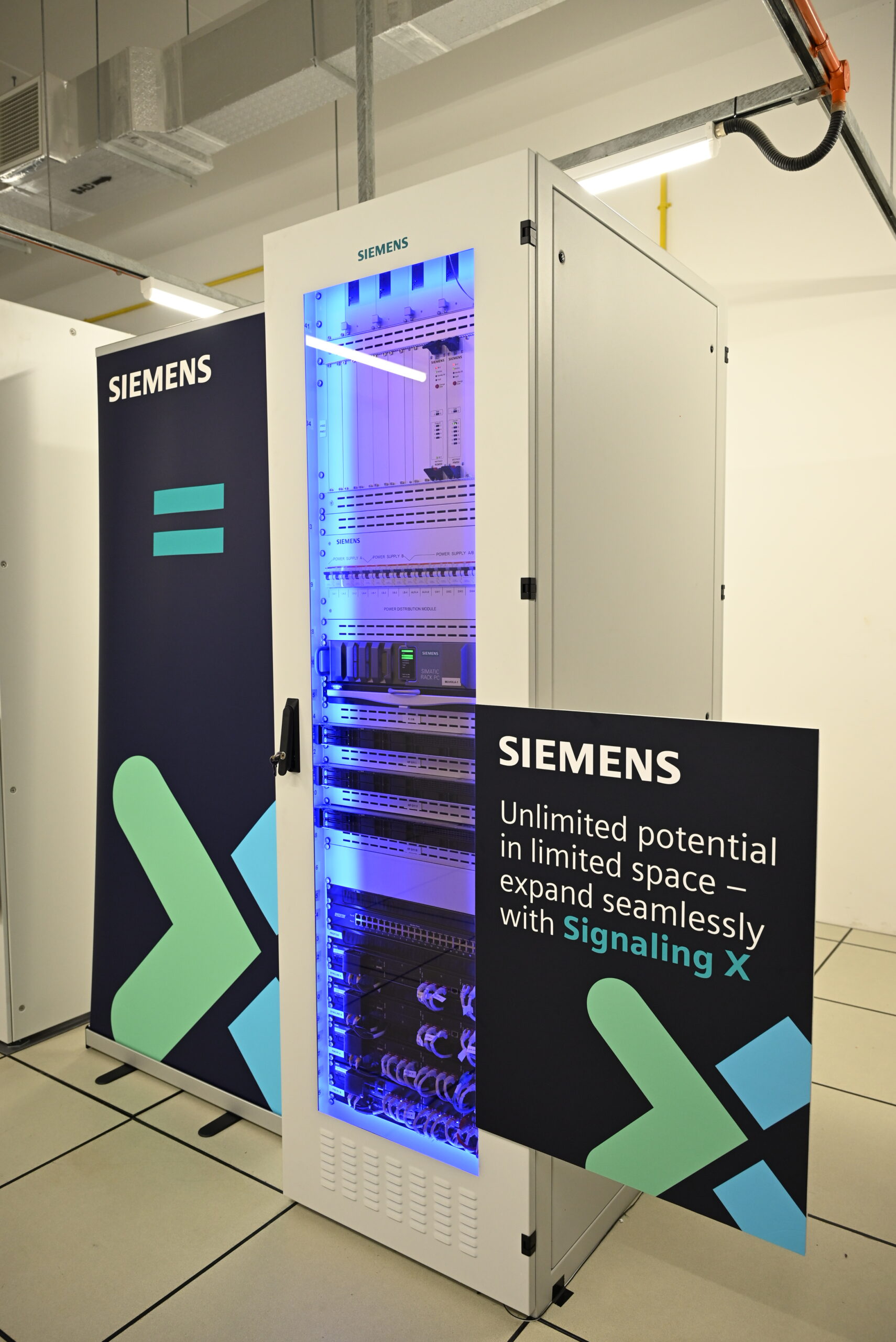
This cloud-ready platform integrates interlockings, signaling systems, and control systems into a centralized, virtualized data center.
Following its successful introduction in mainline rail, Signaling X is now ready for the mass transit market.
As global mobility demand continues to rise, this breakthrough brings Communications-Based Train Control (CBTC) – the state-of-the-art system for metro and urban networks – into a centralized cloud-ready infrastructure, a signalling data center.
“Our groundbreaking solution has already demonstrated its reliability in mainline applications as a globally proven platform with a strong track record,” said Ludwig.
Safety-critical functions run on commercial off-the-shelf (COTS) hardware with Siemens Mobility’s Distributed Smart Safe System (DS3) platform, enabling more trains to run safely at closer intervals.
The Signaling X system aims to achieve up to 20 percent higher operational efficiency and up to 30 percent energy savings, delivering shorter waits and more sustainable mobility.
By deploying safety-critical railway functions, like interlocking logic, and non-safety systems such as timetable management and traffic optimization on the same type of commercial off-the-shelf hardware and through standardized Application Programming Interfaces (APIs), it provides a seamless, efficient approach to rail operations.
APIs are sets of rules and protocols that allow different software applications to communicate with each other and exchange data.
Signaling systems have evolved dramatically to address increasing urban populations and mobility challenges. Historically, rail operations were managed through fixed block systems, which divided tracks into segments where only one train could occupy a section at a time. While this ensured safety, it restricted flexibility and capacity, leading to inefficiencies as cities expanded.
The introduction of Communications-Based Train Control (CBTC) revolutionized rail operations by replacing fixed blocks with real-time, dynamic control. This innovation, known as the Moving Block principle, allows trains to calculate safe braking distances based on their exact position and speed, optimizing capacity, and improving operational efficiency.
Building on CBTC’s success, the rail industry is now entering the next era – signaling digitalization. By centralizing critical functions like interlocking and train control within secure data centers, digitalization minimizes physical trackside equipment, improves flexibility, and sets the stage for future scalability.
Siemens Mobility’s Signaling X transforms rail operations by adopting a digitalized and centralized signaling architecture, powered by the DS3 (Distributed Smart Safe System) safety platform. This combination enables the next generation of rail signaling by moving away from reliance on distributed trackside equipment to a smarter and more flexible system architecture.
Signaling X is already operational in many advanced countries including Austria, Spain and Finland.
Urban mobility is undergoing a profound transformation, shaped by powerful global megatrends. By 2050, the world’s population is projected to reach 9.7 billion (United Nations, 2022), with 68 percent of people living in urban areas (United Nations, 2018).
As cities and metro operators face growing pressure to deliver efficient, reliable, low-emission, and scalable mobility solutions, rail emerges as the backbone of sustainable mobility.
Only a strong, digitally enabled rail sector can meet rising demand while supporting ambitious climate goals.
Siemens Mobility, with its core areas including rolling stock, rail automation and electrification, has posted revenue of €11.4 billion in fiscal 2024 and employed around 41,900 people worldwide. (BVI)
