

By Arun Kumar Das
Indore, July 26 (BVI): Aiming at reducing the Balasore rail mishap-like situations, Indian Railways has introduced the most advanced Drive Electronic Interlocking (EI) systems to minimise the human error in train operations.
The Balasore train accident, which claimed around 300 lives, is believed to have been caused by human error leading to signal fault.
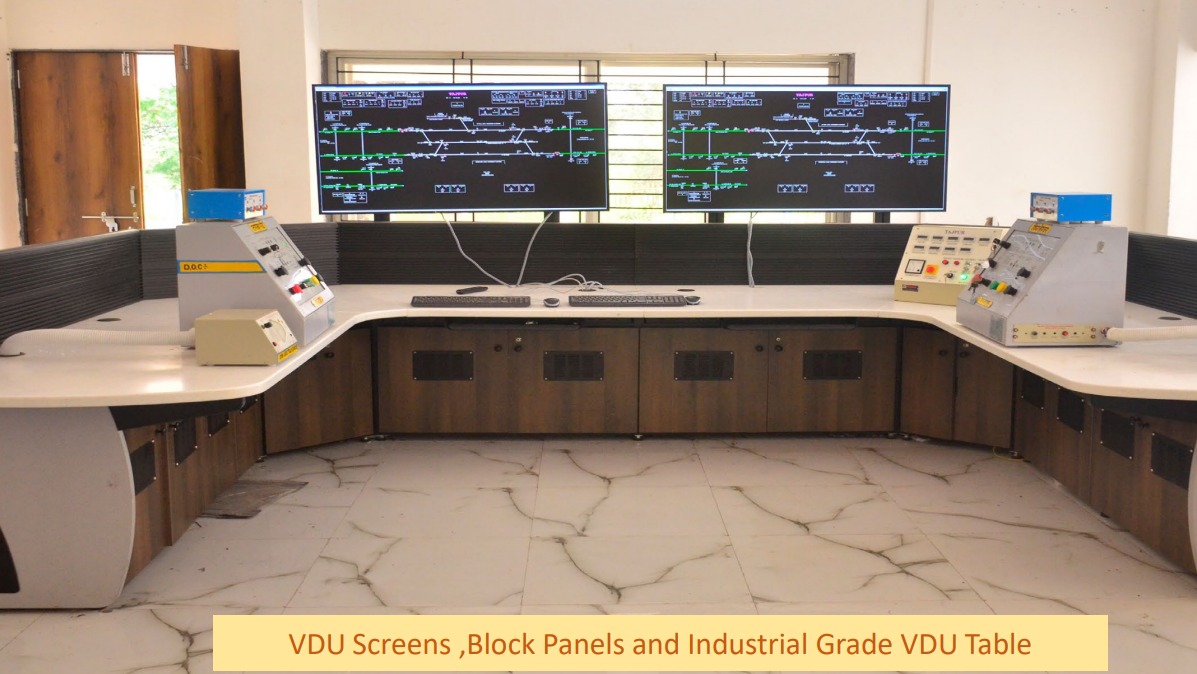
The Kavach-compliant Direct Drive EI system has been commissioned at Tajpur Railway Station in Madhya Pradesh as a pilot project.
Kavach is being installed in rail systems across the country in phase wise to prevent accidents.
Safety is the topmost priority in railway operations and to achieve the objective, Indian Railways is consistently adopting state-of-the-art technologies.
Senior Divisional Signalling and Telecom Engineer of Ratlam division RS Meena said, “In this direction, Western Railway has been replacing the old Panel Interlocking (PI) systems with advanced Electronic Interlocking (EI) systems.”
Taking a step further, Western Railway has achieved a major milestone — for the first time, an advanced Direct Drive Electronic Interlocking (Direct Drive EI) system has been successfully commissioned at Tajpur Railway Station.
With the implementation of this system, Western Railway has become the first zone of Indian Railways to adopt the
Direct Drive EI, a Japanese technology.
What is Direct Drive EI?
The Direct Drive EI system controls the signaling gears directly. It is a computer-based system that ensures a signal is cleared only when all safety conditions for train operations are fully met, such as: All points on the intended route are correctly set and locked.
The route is completely obstruction-free.
Level crossing gates along the route are closed and secured.
This system ensures that only one signal is cleared for a route at any given time, thus preventing conflicting train movements.
Difference between Conventional EI and Direct Drive EI:
In conventional EI systems, signaling gears are operated through relays.
In contrast, Direct Drive EI controls the gears directly, eliminating the need for intermediate relays.
The system can self-detect the status of gears, minimizing the chances of human error.
Since relays are electromechanical devices, the chances of technical failure are significantly reduced in the Direct Drive system.
Technical Advantages:
With the use of Optical Fiber Cables (OFC) in Direct Drive EI, the requirement of traditional copper cables is reduced by 60–70 per cent, offering better protection against lightning and electrical surges.
The number of relays required is also reduced by about 70 per cent, leading to lower maintenance costs and easier fault detection.
The Direct Drive Electronic Interlocking system is emerging as a revolutionary advancement in the field of railway signaling. It not only enhances the safety of train operations but also ensures cost-effective and efficient maintenance.
The commissioning of this system at Tajpur station marks a new benchmark and direction for railway signaling under the Ratlam Division of Western Railway. (BVI)
