
New Development Bank President visits Namo Bharat Rail Corridor; appreciates work
Dilma Rousseff is also the former President of Brazil

By Arun Kumar Das
New Delhi, Mar 9: President of New Development Bank (NDB) Dilma Rousseff visited a Namo Bharat rail station here and appreciated the functioning of the Delhi-Meerut Namo Bharat service and its emphasis on creating a network of networks in the NCR while visiting Namo Bharat Corridor.
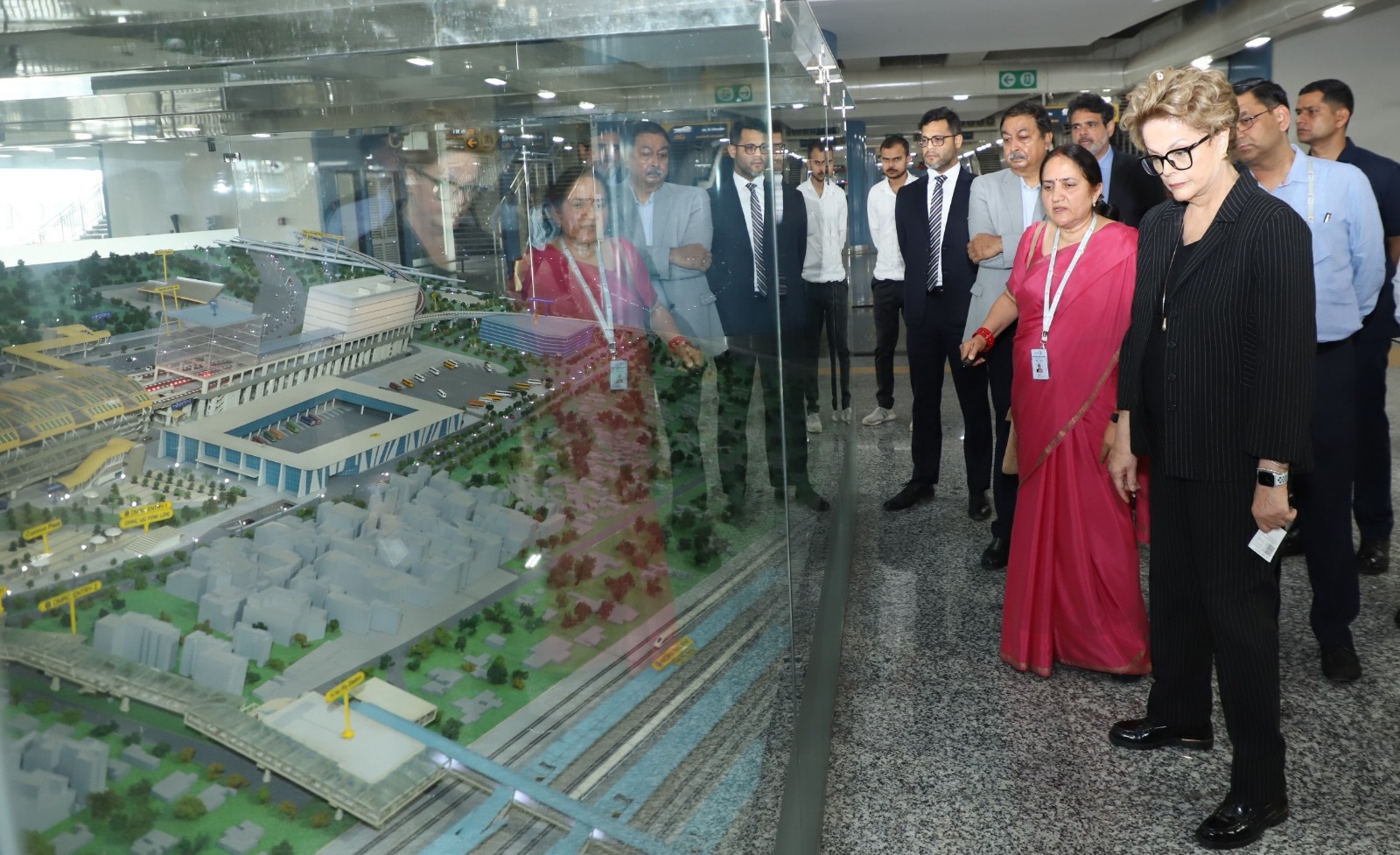
Rousseff, who has also served as the President of Brazil over a decade back, was accompanied by some senior officials of the NDB when she visited the Sarai Kale Khan Namo Bharat Station, the originating station of the Delhi-Meerut corridor.
The delegation was welcomed by Namita Mehrotra, Director/Finance, NCRTC, along with other senior officials on march 9.
The delegation was briefed on the overall vision of India’s first Regional Rapid Transit System (RRTS) which is Namo Bharat, advanced technologies deployed in the project and key innovations that are shaping a new paradigm of regional mobility.
Sarai Kale Khan is emerging as a major multi-modal transit hub with seamless connectivity to Delhi Metro, Railway Station, ISBT, city bus services and the Ring Road.
During the visit, the delegation experienced the station’s integrated design and the emphasis on seamless commuter movement across different modes of public transport.
Rousseff was also informed that all the three priority Namo Bharat corridors of Phase-1 will converge at Sarai Kale Khan and will be interoperable.
Multi-Modal Integration (MMI) has been the tenet of the project.
Namo Bharat stations have been designed in a way to provide integration with existing public transport systems, wherever possible.
This approach will eventually lead to creation of a huge network-of-networks, enable smooth transfers for commuters and encourage a shift from private vehicles to public transport.
The delegation was also apprised of the role of Namo Bharat in addressing key urban mobility challenges in the region such as vehicular congestion and air pollution, while supporting sustainable and balanced regional development.
The project’s potential to enable polycentric growth and transform mobility patterns across the National Capital Region was also discussed, a change that is already becoming visible along the corridor.
As part of the visit, the delegation undertook a round trip on the Namo Bharat train between Sarai Kale Khan and Anand Vihar stations, gaining firsthand experience of the commuter-centric design of the trains and the passenger amenities provided at the stations.
At Anand Vihar, they also observed how multi-modal integration initiatives are facilitating smooth passenger movement on a daily basis.
Rousseff appreciated the inclusive design of both trains and stations and the strong emphasis placed on making the system universally accessible.
The delegation was also briefed on NCRTC’s gender-inclusive operational model.
Rousseff interacted with women train operators and station controllers who form a significant part of the workforce and was appreciative of the efforts made by NCRTC for gender inclusivity and empowerment.
The initiative also reflects the Prime Minister of India’s vision of women-led development, positioning Namo Bharat as a vehicle of women empowerment.
Recently, on February 22, 2026, the Prime Minister dedicated the entire Delhi–Ghaziabad–Meerut Namo Bharat Corridor to the nation, marking a transformative new chapter in the country’s urban mobility landscape. (BVI)
