

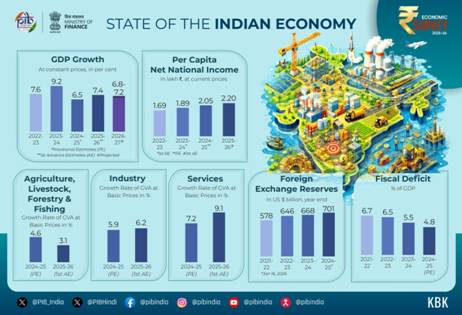
New Delhi, Jan 29 (BVI) India’s GDP growth is expected to be around 7.4% for the current financial year due to increased consumption and investment, according the government’s Economic Survey 2025-26 tabled in Parliament today by Finance Minister Nirmala Sitharaman.
The Survey says the real GDP growth for FY27 is projected at 6.8-7.2 per cent, while the potential growth for India is estimated at around 7 per cent.
The Survey points out that the domestic demand continues to underpin economic growth in FY26.
According to the First Advanced Estimate, the share of final private consumption expenditure (PFCE) in GDP rose to 61.5 per cent in FY26. This strength in consumption reflects a supportive macroeconomic environment, characterised by low inflation, stable employment conditions, and rising real purchasing power.
Moreover, steady rural consumption, bolstered by strong agricultural performance, and the gradual improvement in urban consumption, aided by the rationalisation of direct and indirect taxes, reaffirm that the momentum in consumption demand is broad-based.
Along with consumption, investment has continued to anchor growth in FY26, with the share of gross fixed capital formation (GFCF) estimated at 30.0 per cent.
Investment activity strengthened in the first half of the year, with, GFCF expanding by 7.6 per cent, exceeding the pace recorded in the corresponding period last year and remaining above the pre-pandemic average of 7.1 per cent.
The Survey highlights that Agriculture and allied services are estimated to grow by 3.1 per cent in FY26. Agricultural activity in first half of FY26 was supported by a favourable monsoon.
Agricultural GVA grew by 3.6 per cent, higher than the 2.7 per cent growth recorded in first half of FY25, but remained below the long-term average of 4.5 per cent.
Allied activities, particularly livestock and fisheries, have grown at relatively stable rates of around 5-6 per cent. As their share in agricultural GVA has increased, aggregate agricultural growth has increasingly reflected a weighted outcome of volatile crop performance and a relatively stable expansion in allied sectors.
The Economic Survey mentions that the industrial sector is showing signs of strength, with manufacturing growing by 8.4 per cent in the first half of FY26, surpassing the FY26 estimate of 7.0 per cent.
Additionally, the construction industry has remained resilient, underpinned by sustained public capital expenditure and ongoing momentum in infrastructure projects. The manufacturing sector share has remained steady at around 17-18 per cent in real (constant) price terms.
Manufacturing’s gross value of output (GVO) has remained broadly stable at around 38 per cent, comparable to services, indicating that output has been sustained.
Moreover, in FY26, the industrial sector is expected to gain momentum, growing at 6.2 per cent, up from 5.9 per cent in FY25.
The high-frequency indicators for Q3 of FY26, including the PMI manufacturing, IIP manufacturing, and e-way bill generation, signal a strengthening of manufacturing activity underpinned by robust demand.
Construction indicators, such as steel consumption and cement production, have witnessed a steady growth.
Looking ahead, momentum in industrial activity is expected to remain buoyant, boosted by the rationalisation of GST and a favourable demand outlook.
The Economic Survey highlights that on the supply side, services remain the main driver of growth. In the first half of FY26, the Gross Value Added (GVA) for services increased by 9.3 per cent, with an estimated 9.1 per cent growth for the entire fiscal year.
This trend indicates a broad-based expansion across the sector. Within the service sector, all sub-segments have grown past 9 per cent, save for the heavily Covid-impacted ‘trade, hospitality, transport, communication and related services, which is still 50 basis points away from the pre-pandemic average.
The Economic Survey mentions demand-led growth in the economy has unfolded alongside a marked easing of inflation, which has improved real purchasing power and supported consumption.
Domestic inflation dynamics in FY26 (April-December) reflect a broad-based easing in price pressures, led by a sharp disinflation in food prices.
Headline CPI inflation declined to 1.7 per cent, driven primarily by corrections in vegetable and pulse prices, supported by favourable farm conditions, supply-side interventions, and a strong base effect.
While core inflation has exhibited persistence, this has been largely influenced by price spikes in precious metals; adjusting for these, underlying inflation pressures appear materially softer, indicating limited demand-side overheating.
Looking ahead, the inflation outlook remains benign, supported by favourable supply side conditions and the gradual pass-through of GST rate rationalisation.
The Survey states that the momentum in domestic demand and capital formation observed in FY26 has been underpinned by a prudent fiscal policy strategy, characterised by steady revenue mobilisation and calibrated expenditure rationalisation.
The gross tax revenue collection has progressed resiliently during the year, with direct tax collections reaching nearly 53 per cent of the budgeted annual target (as on November 2025).
Indirect tax collections also remained robust despite lower inflation and import volatility, with gross GST collections in absolute terms recording multiple all-time highs during the year.
Recent tax policy reforms, including the restructuring of personal income tax and the rationalisation of the GST rate, have supported consumption demand while sustaining revenues in absolute terms.
On the expenditure side, capital outlays recorded a strong year-over-year increase, reaching nearly 60 per cent of the budgeted allocation by November 2025. Also, the growth in revenue expenditure remained contained, reinforcing the quality of public spending.
The Economic Survey mentions that against a backdrop of global trade uncertainty, India’s total exports (merchandise and services) reached a record USD 825.3 billion in FY25, with continued momentum in FY26.
Despite heightened tariffs imposed by the United States, merchandise exports grew by 2.4 per cent (April–December 2025), while services exports increased by 6.5 per cent. Merchandise imports for April-December 2025 increased by 5.9 per cent.
Following the trends in previous years, the rise in merchandise trade deficit has been counterbalanced by an increase in services trade surplus, while the growth in remittances has bolstered this balance.
In most years, remittances have surpassed gross FDI inflows, underscoring their importance as a key source of external funding. As a result, the current account deficit remains moderate at 0.8 per cent of GDP in H1 FY26.
India’s external sector is placed comfortably in the short run. Forex reserves cover over 11 months of imports as of 16 January 2026 and approximately 94.0 per cent of the external debt outstanding as of the end of September 2025, offering a comfortable liquidity cushion.
The pursuit of a diversified trade strategy, as evidenced by the signing of trade agreements with the UK, Oman, and New Zealand, and the recently concluded free trade agreement with the European Union after three years of negotiations, which will now require ratification by the European Parliament. Moreover, the active negotiations with the US, bodes well for India’s exports.
The Union government’s landmark step of notifying the implementation of the Labour Codes marks a significant reform in the regulatory framework.
The consolidation of 29 central laws into four Labour Codes aims to simplify compliance, enhance labour market flexibility, and extend security to a broader section of the workforce, while maintaining safeguards for wages, occupational safety, and social security.
The FY26 was an unusually challenging year for the economy on the external front. Heightened uncertainty in global trade and the imposition of high, penal tariffs created stress for manufacturers, particularly exporters, and affected business confidence.
The government responded by using this crisis as an opportunity to push through key measures such as GST rationalisation, faster progress on deregulation, and further simplification of compliance requirements across sectors.
FY27 is therefore expected to be a year of adjustment, as firms and households adapt to these changes, with domestic demand and investment gaining strength. That said, it must be acknowledged that the external environment remains uncertain, which shapes the overall outlook.
The Survey points out that the global environment remains fragile, with growth holding up better than expected but risks elevated amid intensifying geopolitical tensions, trade fragmentation and financial vulnerabilities.The impact of these shocks may still surface with a lag.
For India, the global conditions translate into external uncertainties rather than immediate macroeconomic stress. Slower growth in key trading partners, tariff induced disruptions to trade and volatility in capital flows could intermittently weigh on exports and investor sentiment.
At the same time, ongoing trade negotiations with the United States are expected to conclude during the year, which could help reduce uncertainty on the external front. While these risks remain manageable, they reinforce the importance of maintaining adequate buffers and policy credibility.
Against this backdrop, the domestic economy remains on a stable footing. Inflation has moderated to historically low levels, although some firming is expected to occur going forward.
Balance sheets across households, firms and banks are healthier, and public investment continues to support activity. Consumption demand remains resilient, and private investment intentions are improving.
These conditions provide resilience against external shocks and support the continuation of growth momentum. The forthcoming rebasing of the CPI series in the coming year will also have implications for inflation assessment and warrant careful interpretation of price dynamics.
Importantly, the cumulative impact of policy reforms over recent years appears to have lifted the economy’s medium-term growth potential closer to 7 per cent.
With domestic drivers playing a dominant role and macroeconomic stability well anchored, the balance of risks around growth remains broadly even. (BVI)
