

By Arun Kumar Das
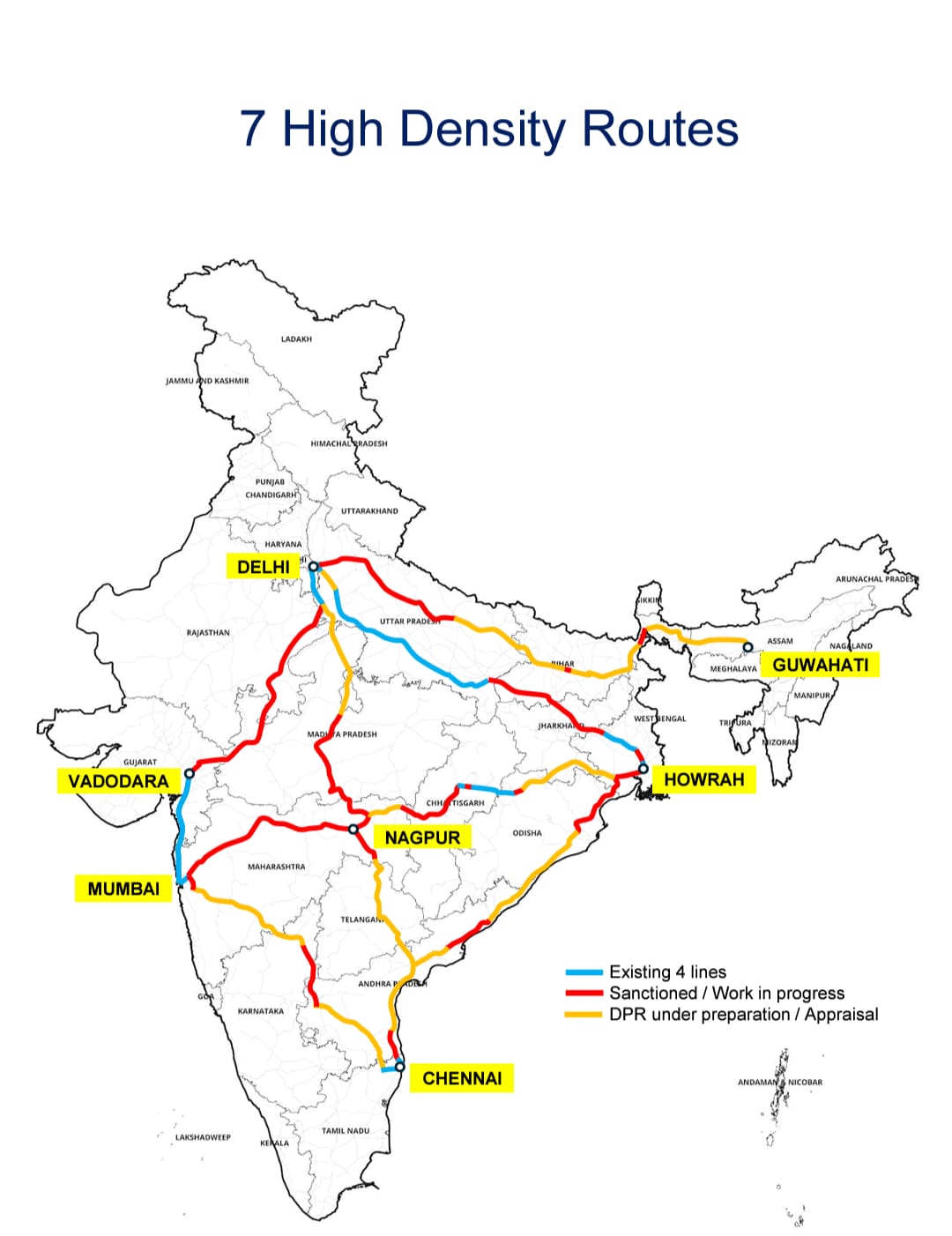
New Delhi: Indian Railways is moving towards four-laning seven high-density rail routes covering nearly 11,000 km to increase capacity and support the growing movement of passengers and freight across the country.
The corridors carry around 41 per cent of total railway traffic while covering just 16 per cent of the railway network and connect major cities including Delhi, Mumbai, Chennai and Howrah, making them crucial for both passenger and freight trains.
Railway Minister Ashwini Vaishnaw has outlined the scale and significance of the seven high-density railway routes that carry a major share of Bharat’s total rail traffic.
The seven high-density routes identified are Delhi–Howrah, Howrah–Chennai, Chennai–Mumbai, Mumbai–Delhi, Delhi–Chennai, Mumbai–Howrah and Delhi–Guwahati.
Recently, the Cabinet Committee on Economic Affairs approved construction of third and fourth lines of a 90 km stretch between Gummidipoondi and Gudur, at a cost of about ₹2,229 crore.
The project is part of the Howrah–Chennai corridor, where the existing double-line section has a projected line capacity utilisation of 131 per cent.
The Centre has also approved the 173km Kharagpur–Bhadrak fourth line and 75km Bhadrak–Haridaspur fourth line as part of efforts to expand capacity along the corridor.
Work on the Delhi–Chennai corridor, covering about 2,174km, is also underway, with a 203km third line between Kazipet and Balharshah, costing around ₹3,000 crore, completed in July. A 14km Tadali–Ghugus doubling project in Maharashtra has also been sanctioned at ₹228 crore. The third city-linked route, Chennai–Mumbai, covers about 1,289km.
“To reduce the cost of logistics in our country and simultaneously make our transportation green as we grow our economy, we must make sure these important corridors are quadrupled so that the capacity increases,” said Vaishnaw and added the ongoing expansion work is aimed at creating four railway lines across the high-density network, helping increase capacity on some of the busiest routes in the country.
The expansion of these high-density routes is significant as it will help create more capacity across the railway network and support the future growth of passenger and freight traffic. (BVI)
