

By Arun Kumar Das
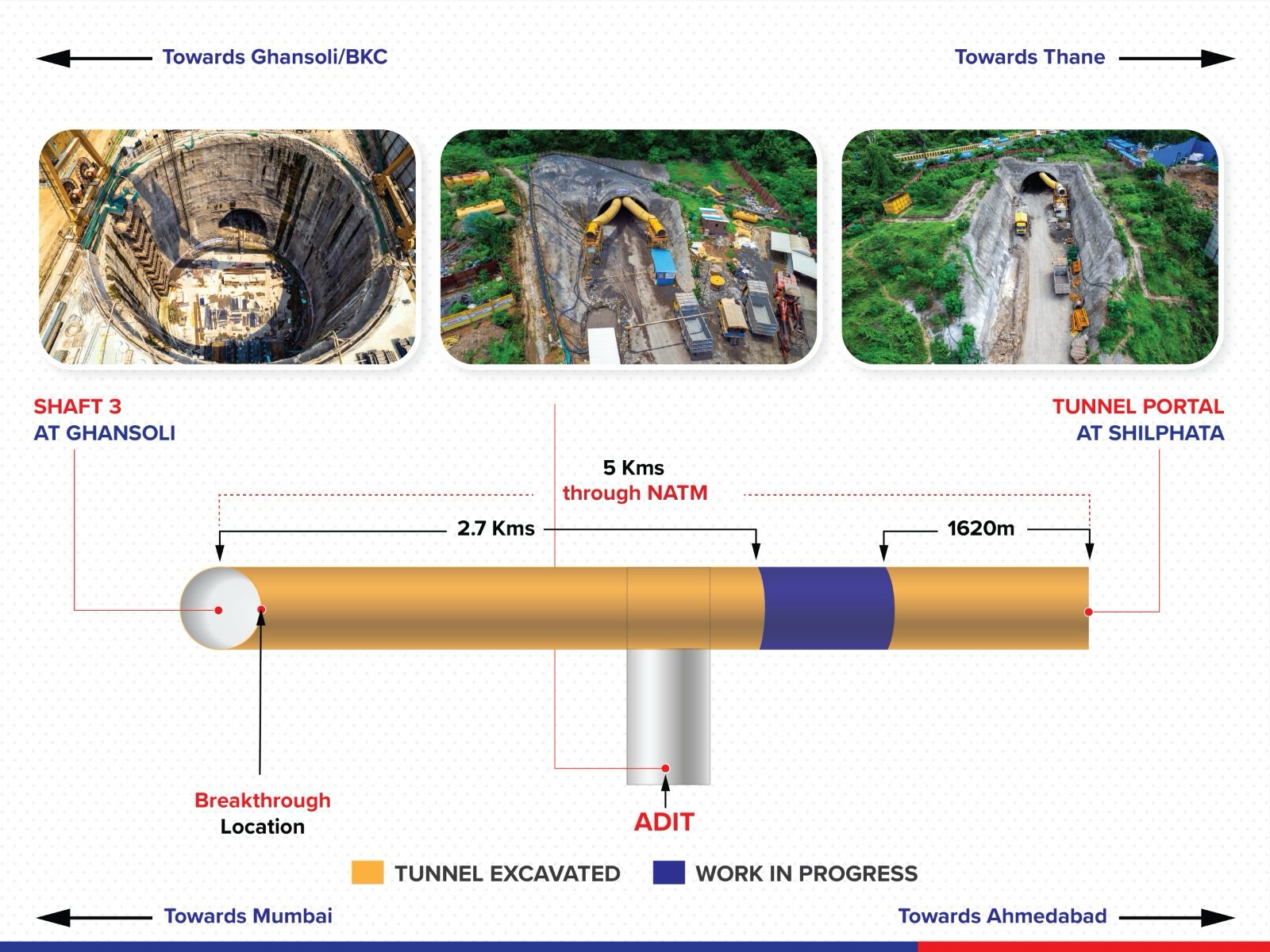
New Delhi, Jul 11 (BVI): A major engineering achievement by National High Speed Rail Corporation in the bullet train project with the completion of the successful completion of a 2.7 km continuous tunnel section in the 21 km underground and undersea tunnel being built between Bandra-Kurla Complex (BKC) and Shilphata in the Maharashtra stretch.
This tunnel includes a 7 km stretch under Thane Creek and is being constructed using two methods—Tunnel Boring Machines (TBMs) for 16 km and the New Austrian Tunnelling Method (NATM) for the remaining 5 km.
The tunnel also includes a 7 km long undersea section beneath Thane Creek.
A cumulative 4.1 km of tunnel excavation has been completed so far using NATM from Shilphata and two ADIT (Additionally Driven Intermediate Tunnel) faces.
Further, casting of Base Slab at both Vikhroli (at a depth of 56 meters) and Sawli shaft (at a depth of 39 meters) is complete, the NHSRCL said.
Meanwhile, excavation work is underway for seven mountain tunnels in Maharashtra’s Palghar district, while structural works for all eight bullet train stations in Gujarat have been completed.
In order to expedite tunnelling in the NATM portion, an Additional Driven Intermediate Tunnel (ADIT) was constructed, allowing simultaneous excavation towards Ghansoli and Shilphata sides. So far, about 1.62 km has been excavated from the Shilphata side, and the total progress in the NATM section stands at approximately 4.3 km.
Comprehensive safety measures have been implemented at the site, including ground settlement markers, piezometers, inclinometers, strain gauges, and biometric access control systems to ensure safe and controlled tunnelling activities without disturbing nearby structures.
The Mumbai-Ahmedabad bullet train project, India’s first high-speed rail corridor, is hitting major construction milestones, with over 300 km of viaduct constructed.
According to National High Speed Rail Corporation Limited (NHSRC), the implementing agency for the bullet train project, 309 km of viaduct and 392 km of pier work for the project have been completed.
The agency said that 406 km of piers foundation work has been completed and 331 km of girders cast is finished.
The project has also completed 16 river bridges, 8 steel bridges, and 5 pre-stressed concrete (PSC) bridges.
Further, over 3.6 lakh noise barriers have been installed across the high-speed rail corridor.
RC trackbed construction is well underway, with 176 km completed so far, according to NHSRCL.
Over 44,600 track slabs have been cast for the project, covering around 213 track km.
Meanwhile, the bullet Train project’s power Infrastructure has also begun to take shape with installation of over 1,000 overhead equipment (OHE) masts.
OHE masts are now rising along the Mumbai-Ahmedabad Bullet Train corridor in Navsari district, Gujarat, marking a key step in the electrification of India’s first high-speed rail line.
These precision-engineered steel structures, essential for delivering power to trains running at 320 kmph, are part of a larger rollout of more than 20,000 masts planned across the entire corridor.
According to the National High-Speed Rail Corporation Limited (NHSRCL), over 1,000 OHE masts have already been installed, covering 25 km of the viaduct in the Navsari section.
